Velodyne Lidar’s Sponsorship of Autonomous Vehicle Competition in China Advances Research and Development of Self-Driving Cars
Velodyne’s Support of IVFC Accelerates Autonomous Vehicle Development
At the 10th China Intelligent Vehicles Future Challenge (IVFC), Velodyne Lidar, Inc. sensors played a prominent role in enabling self-driving vehicles from multiple teams to navigate real and complex road traffic environments. As an IVFC sponsor, Velodyne had its industry-leading lidar sensors on 20 of the 27 participating teams, including the competition's winner, at the longest-running and most authoritative autonomous vehicle (AV) contest in China.
The IVFC, which took place in Changshu, Suzhou, China in November 2018, attracted a diverse group of teams looking to showcase their latest developments in AV technology. In addition to teams from university research institutes, innovative startup companies and vehicle manufacturers engaged in developing driverless cars participated in the competition. The challenge was hosted by the National Natural Science Foundation of China and organized by the Changshu Municipal People's Government.
The challenge included both real-road and offline testing of environmental perception. In the real-road test, the self-driving vehicles competed on urban roads, suburban roads, and elevated expressways. Vehicles navigated dense human-driving traffic flow and various adversarial conditions like GPS-signal loss, road construction, crossing pedestrians, and heavy rain.
The IVFC winner was the "Pioneer" team from the Institute of Artificial Intelligence and Robotics, Xi'an Jiaotong University and Sunny Optical Technology Co., Ltd., which was equipped with one Velodyne Ultra Puck™ and two Velodyne Puck™ sensors. Velodyne will award the winners with one Velodyne HDL-64E and two Velodyne Puck™ sensors for future AV development.
"The IVFC provides an excellent opportunity for our next-generation scientists and engineers to strengthen their research and development abilities in the field of autonomous vehicles and build new cooperative relationships with colleagues from throughout China," said Dr. Chi Zhang, Xi'an Jiaotong University, who was a referee in the 10th IVFC. "This competition also involves instrumental verification for advancing our AV industry and having Velodyne, the lidar market leader, participate brings invaluable expertise and experience to this learning environment."
"The Intelligent Vehicles Future Challenge has long had a leading role in promoting innovation and practical application of autonomous vehicle technology in China," said Wei Weng, Executive Director APAC, Velodyne Lidar. "Velodyne feels privileged to work closely with the prestigious government, academic, business, and research organizations involved in the IVFC to advance the research and development skills of these creative engineers so they can contribute to accelerating the growth of the AV industry."
About Velodyne Lidar
Velodyne provides the smartest, most powerful lidar solutions for autonomy and driver assistance. Founded in 1983 and headquartered in San Jose, Calif., Velodyne is known worldwide for its portfolio of breakthrough lidar sensor technologies. In 2005, Velodyne's Founder and CEO, David Hall, invented real-time surround view lidar systems, revolutionizing perception and autonomy for automotive, new mobility, mapping, robotics, and security. Velodyne's high-performance product line includes a broad range of sensing solutions, including the cost-effective Puck™, the versatile Ultra Puck™, the perfect for L4-L5 autonomy Alpha Puck™, the ultra-wide angle VelaDome™, the ADAS-optimized Velarray™, and the groundbreaking software for driver assistance, Vella™.
Featured Product
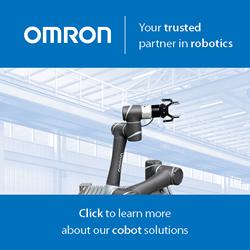
Discover how human-robot collaboration can take flexibility to new heights!
Humans and robots can now share tasks - and this new partnership is on the verge of revolutionizing the production line. Today's drivers like data-driven services, decreasing product lifetimes and the need for product differentiation are putting flexibility paramount, and no technology is better suited to meet these needs than the Omron TM Series Collaborative Robot. With force feedback, collision detection technology and an intuitive, hand-guided teaching mechanism, the TM Series cobot is designed to work in immediate proximity to a human worker and is easier than ever to train on new tasks.