Datakit expands its range of Rhino plug-ins
The French specialist in data transfer for CAD systems adds to their Rhino offer with new plug-ins for CreoView, Revit and IFC formats. This has also led to the creation of a bundle aimed the world of architecture and construction.
Rhinoceros 3D, more commonly known as Rhino 3D, is a computer-aided design software developed by Robert McNeel & Associates in 1992. Users have always really appreciated it, particularly those working in the fields of industrial design or architecture, for its ease of modeling complex shapes in 3D.
It's this ease of modeling that makes makes people use it together with many other CAD systems. But for that you still need to be able to easily transfer 3D models from one system to another, which is exactly what the import and export plug-ins developed by Datakit will do.
This Lyon (France) publisher, partner of a hundred publishers worldwide, has been offering since 1994 a whole range of tools to exchange data between CAD systems:
- Conversion engine, CrossCad/Ware;
- Standalone converters, CrossManager;
- Plug-ins, CrossCad/Plg.
"These are tools that our customers really appreciate because, apart from the fast and efficient data processing and the option to work in batch mode, they also value the ease of installation and use, regular updates, and the customer service efficiency", states Olivier Rigollet, CEO of Datakit.
Three new plug-ins for Rhino
The Rhino 3D import plug-ins, which already support 12 exchange formats, have been enhanced after the October update with three new formats:
- Revit, 3D CAD software for architecture by Autodesk;
- IFC, interoperability format for BIM (Industry Foundation Classes);
- Creo View, 3D visualization software from PTC's Creo products.
These plug-ins only require a Rhino 3D license on the workstation where they're going to be used and use the same environment and resources as the software.
These three new plug-ins are available individually for 1200€ for a fixed license or in bundles that include several plug-ins.
Two bundles depending on the use
These three new plug-ins have led to the creation of a bundle dedicated to the world of architecture that one can now find with the existing general import bundle.
- The Creo View plug-in is integrated into the existing Rhino import bundle, which now supports 13 formats and is available for 1500€. Users who own this general bundle and have it up to date can get this new plug-in free of charge.
- Revit and IFC plug-ins are the subject of a new BIM bundle for Rhino, which is available for 1200€, which is quite a good economic investment for Rhino 3D users working in the field of architecture and construction.
The Rhino plug-ins are based on Datakit's topological model that, in addition to a perfect re-reading of the native geometrical data, makes it possible to manage links between these geometries, which offers the possibility of working from exact solids similar to those generated in the source software. These plug-ins are fully compatible with the creation and deformation of solids in Rhino 4.0, 5.0 and 6.0.
Datakit, the publisher with the widest range of plug-in formats for Rhino 3D, is also Robert McNeel & Associates' provider of the default SolidWorks reading tools included in Rhino 3D.
So, no Rhino 3D without Datakit plug-ins!
To find out more, visit https://www.datakit.com/en/conversion-plug-ins/rhino-25.html
Featured Product
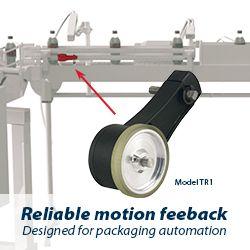
Model TR1 Tru-Trac
The Model TR1 Tru-Trac® linear measurement solution is a versatile option for tracking velocity, position, or distance over a wide variety of surfaces. An integrated encoder, measuring wheel, and spring-loaded torsion arm in one, compact unit, the Model TR1 is easy to install. The spring-loaded torsion arm offers adjustable torsion load, allowing the Model TR1 to be mounted in almost any orientation - even upside-down. The threaded shaft on the pivot axis is field reversible, providing mounting access from either side. With operating speeds up to 3000 feet per minute, a wide variety of configuration options - including multiple wheel material options - and a housing made from a durable, conductive composite material that minimizes static buildup, the Model TR1 Tru-Trac® is the ideal solution for countless applications.