
SwRI demonstrates SWORDâ„¢ robotics programming software at Automate 2025
SWORD integrates CAD with open-source ROS tools to streamline automation
SAN ANTONIO - May 13, 2025 -Southwest Research Institute (SwRI) is simplifying robotics programming with software that models, plans and executes automation in a user-friendly environment. The SwRI Workbench for Offline Robotics Development (SWORDâ„¢) accelerates robotics development by reducing the manual coding required for complex applications.
SWORD users work in a computer-aided design (CAD) 3D environment, leveraging novel robotic modeling to configure systems and plan motion on robotic arms, tools and work cells. SWORD connects 3D visualizations to integrated robot operating system (ROS) software modules, rapidly converting digital simulations into executable processes and free-space robotic motions deployed in physical hardware.
"We put a lot of thought into creating a tool that simulates robotic movement then converts it into a set of commands that run on hardware," said Michael Ripperger, who is leading SWORD development. "It can be used by robotics experts, and it's intuitive design is particularly useful for manufacturing engineers who don't have a coding background."
SwRI will demonstrate SWORD during the Automate show May 12-15 in Detroit. Attendees can visit Booth No. 5607 to see a live demonstration of a robot arm programmed in SWORD to set up process paths for a part shaped like a jigsaw puzzle piece in the CAD interface.
"The demo shows how SWORD can unlock complex applications that would otherwise be cost prohibitive and time consuming with manual coding," Ripperger said.
The traditional ROS-Industrial workflow requires developers to be deeply familiar with programming languages and software code libraries. Even experienced developers within the ROS-I ecosystem and beyond may spend weeks on the initial setup of a ROS application.
SwRI manages the ROS-Industrial Americas Consortium and supports ROS-I software repositories, executing training and developer events. SwRI developed SWORD so manufacturing engineers with CAD knowledge can leverage complex capabilities within the ROS codebase.
SWORD is a plugin to the FreeCAD application with a graphical toolkit that builds motion planning environments and collision geometries and tests advanced robotic motion-planning applications.
"A major goal in developing SWORD is to adapt ROS for manufacturing and industrial audiences in a way that is more approachable in a familiar environment," said Matt Robinson, an SwRI program manager who oversees the ROS-Industrial Americas Consortium.
Key SWORD features include:
• Environmental Modeling: Create or import a CAD model of your robot, including fixtures and end-of-arm-tooling. Users can evaluate and calculate joint configurations by manipulating and controlling robot models using joint sliders and simulating tool movement with an intuitive dragger.
• Robot Manipulation and Planning: Generate motion plans using commercial path planners, creating custom pipelines for application-specific behavior while predicting and avoiding collisions.
• Custom Planning Pipeline: Define robot motion using either coordinate-based or joint waypoints, specifying different movement segment types and motion groups while inserting supplementary commands.
To inquire about a trial license, visit https://sword.swri.org or listen to Robinson and Ripperger discuss SWORD on the Technology Today Podcast.
About SwRI:
SwRI is an independent, nonprofit, applied research and development organization based in San Antonio, Texas, with more than 3,200 employees and an annual research volume of $915 million. Southwest Research Institute and SwRI are registered marks in the U.S. Patent and Trademark Office. For more information, please visit www.swri.org.
Featured Product
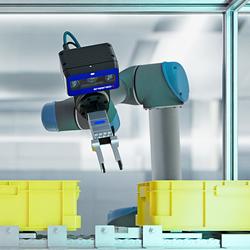
Nion: Next-level time-of-flight
The new Nion 3D camera advances Time-of-Flight (ToF) technology with exceptional resolution, speed, and industrial robustness. Designed for demanding applications such as logistics, warehousing, industrial automation, and robotics, Nion delivers high-resolution depth data with real-time performance for faster, safer, and more flexible operations. At its core is the 1.2-megapixel Time-of-Flight sensor AF0130 from onsemi's Hyperlux ID family, offering up to four times the resolution of conventional VGA-based ToF cameras and significantly higher data density. Active 940-nm laser illumination ensures accurate and stable measurements in low-light conditions, artificial lighting, and even direct sunlight. With an IP67-rated housing, Nion is built for reliable operation in dusty, wet, and thermally challenging industrial environments. A user-friendly API with IDS peak support and compliance with the GigE Vision standard enable fast integration and flexible deployment in high-resolution 3D applications. The Nion 3D camera is now available from IDS Imaging Development Systems.
