Teledyne FLIR’s Black Hornet 4 Nano-Drone Approved for Defense Innovation Unit’s Blue UAS List
Award-winning Black Hornet unmanned aerial system is deployed in more than 45 countries
Teledyne FLIR Defense, part of Teledyne Technologies Incorporated (NYSE:TDY), announced that its Black Hornet® 4 Personal Reconnaissance System has successfully completed the required NDAA and cyber security verification process and been approved for the Blue UAS List with an Authority to Operate.
Led by the Defense Innovation Unit (DIU), Blue UAS vets and verifies commercial drone technology for the Department of Defense and U.S. government. The Blue UAS List gives users access to a wide range of drone systems that can meet their diverse needs. In February Teledyne FLIR announced that Black Hornet 4 was selected by DoD operators from among more than 35 uncrewed aerial system (UAS) products, all rigorously tested during DIU's 'Blue UAS Refresh' event.
"We are honored to see Black Hornet 4 added to the Blue UAS List, knowing that more operators across our military and federal government will be able to benefit from this one-of-a-kind drone and its distinct capabilities," said Dr. JihFen Lei, president of Teledyne FLIR Defense. "DIU is filling a critical national need in meeting mission requirements by executing a more expansive Blue UAS program, and we have valued our partnership with them throughout the verification process."
Black Hornet 4 represents the next generation of lightweight nano-drones, able to provide enhanced covert situational awareness to small fighting units. Its 12-megapixel daytime camera and high-resolution thermal imager deliver crisp video and still images to the operator. At just 70 grams Black Hornet 4 can fly for more than 30 minutes, over three kilometers, and function in 25-knot winds and rain. Flight performance is augmented by advanced obstacle avoidance capabilities and other features.
In May, FLIR Defense opened a new 13,000 sq ft facility in Somerset, Kentucky that will function as a major support hub for servicing, testing, and training on Black Hornet systems used by U.S. armed forces.
FLIR Defense has delivered more than 33,000 Black Hornet drones to military and security forces in over 45 countries. The U.S. Army began acquiring Black Hornet systems in 2018 for its Soldier Borne Sensor (SBS) program. Since then, it has placed orders under SBS and other contract vehicles totaling more than $300 million.
The award-winning Black Hornet is designed and built by Teledyne FLIR Defense in Norway.
About Teledyne FLIR Defense
Teledyne FLIR Defense has been providing advanced, mission-critical technology and systems for more than 45 years. Our products are on the frontlines of the world's most pressing military, security and public safety challenges. As a global leader in thermal imaging, we design and build sophisticated surveillance sensors for air, land and maritime use. We develop the most rugged, trusted unmanned air and ground platforms, as well as intelligent sensing devices used to detect chemicals, biological agents, radiation and explosives. At Teledyne FLIR Defense we bring together this expertise to deliver solutions that enable critical decisions and keep our world safe - from any threat, anywhere. To learn more, visit us online or follow @flir and @flir_defense.
About Teledyne Technologies
Teledyne Technologies is a leading provider of sophisticated digital imaging products and software, instrumentation, aerospace and defense electronics, and engineered systems. Teledyne's operations are primarily located in the United States, the United Kingdom, Canada, and Western and Northern Europe. For more information, visit Teledyne's website at www.teledyne.com.
Featured Product
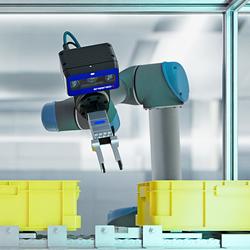
Nion: Next-level time-of-flight
The new Nion 3D camera advances Time-of-Flight (ToF) technology with exceptional resolution, speed, and industrial robustness. Designed for demanding applications such as logistics, warehousing, industrial automation, and robotics, Nion delivers high-resolution depth data with real-time performance for faster, safer, and more flexible operations. At its core is the 1.2-megapixel Time-of-Flight sensor AF0130 from onsemi's Hyperlux ID family, offering up to four times the resolution of conventional VGA-based ToF cameras and significantly higher data density. Active 940-nm laser illumination ensures accurate and stable measurements in low-light conditions, artificial lighting, and even direct sunlight. With an IP67-rated housing, Nion is built for reliable operation in dusty, wet, and thermally challenging industrial environments. A user-friendly API with IDS peak support and compliance with the GigE Vision standard enable fast integration and flexible deployment in high-resolution 3D applications. The Nion 3D camera is now available from IDS Imaging Development Systems.