
XTEND AI Robotics, Inc. Secures U.S. Patent for NEST Autonomous Base Station, for Persistent Robotic Operations
XTEND’s NEST enables robotic systems to autonomously deploy, recover and recharge, supporting persistent operations with reduced human intervention
XTEND AI Robotics, Inc. (NYSE: XTND), a leader in software systems and Physical AI, today announced that the United States Patent and Trademark Office has granted U.S. Design Patent No. D1,147,179 for NEST, XTEND's autonomous base station for persistent robotic operations. The design patent issued on September 8, 2026.
Powered by XTEND's proprietary XOS operating system, the NEST enables robotic systems to autonomously launch, execute missions, recover and recharge, creating a persistent operational cycle that can be remotely managed with reduced human intervention.
The NEST provides the infrastructure required to keep robotic systems deployed and mission-ready for extended operations. Multiple systems can be coordinated across distributed locations, supporting persistent situational awareness and scalable robotic coverage while reducing the need to position personnel in forward or high-risk environments.
The U.S. design patent protects the ornamental design of the NEST's physical configuration. The grant expands XTEND's intellectual property portfolio as the company continues to develop the software, robotic platforms and supporting infrastructure required to deploy autonomous robotic workforces at scale.
"The NEST extends autonomy beyond the robot itself," said Aviv Shapira, Co-Founder and CEO of XTEND. "A robotic workforce needs more than autonomous machines. It needs the infrastructure that allows those machines to remain deployed, mission-ready and connected over time. The NEST is an important part of that infrastructure, helping us build persistent Physical AI systems that can operate where sending people would create unnecessary risk."
The patent adds to XTEND's intellectual property portfolio as the company continues to develop the software, robotic platforms and infrastructure required to deploy autonomous robotic workforces at scale.
Featured Product
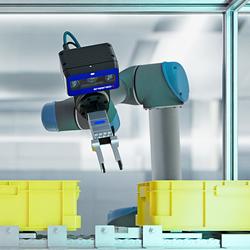
Nion: Next-level time-of-flight
The new Nion 3D camera advances Time-of-Flight (ToF) technology with exceptional resolution, speed, and industrial robustness. Designed for demanding applications such as logistics, warehousing, industrial automation, and robotics, Nion delivers high-resolution depth data with real-time performance for faster, safer, and more flexible operations. At its core is the 1.2-megapixel Time-of-Flight sensor AF0130 from onsemi's Hyperlux ID family, offering up to four times the resolution of conventional VGA-based ToF cameras and significantly higher data density. Active 940-nm laser illumination ensures accurate and stable measurements in low-light conditions, artificial lighting, and even direct sunlight. With an IP67-rated housing, Nion is built for reliable operation in dusty, wet, and thermally challenging industrial environments. A user-friendly API with IDS peak support and compliance with the GigE Vision standard enable fast integration and flexible deployment in high-resolution 3D applications. The Nion 3D camera is now available from IDS Imaging Development Systems.
