Odos Imaging 2+3D Sensor

Odos imaging's 1.3 mega­pixel 2+3D camera can capture accurate 3D images at 100 frames per second; allowing the system to capture very fast moving objects without degradation even in the brightest sunlight. Combining proprietary technology with conventional 2D image capture, an Odos imaging solution provides unambiguous 3D images at video rates from a single unit. Very short, intense pulses of invisible light are used to illuminate the scene. The high intensity of the pulse minimizes the effect of ambient light and allows for outdoor operation. These pulses are reflected by objects within the scene and are detected by the image sensor. Proprietary algorithms convert the detected pulses into a distance measurement. Simultaneously, a conventional 2D image of the scene is captured. Each pixel on the sensor provides both distance and intensity information. 

How Google's Self-Driving Car Works

IEEE Spectrum has an article explaining how Google's new autonomous vehicles project works. The article is based on a recent presentation that Sebastian Thrun and Chris Urmson gave at keynote speech at the IEEE International Conference on Intelligent Robots and Systems. The article can be found here.

IROS 2011 Montage

The IEEE International Conference on Intelligent Robots and Systems took place a few weeks ago in San Francisco. Willow Garage put together a nice montage video of some of the robots on display. Enjoy.  

A Robot Playing Jenga

Torsten Kröger of Standford programmed a robot arm to play the block stacking game Jenga in order to demonstrate the potential of multi-sensor integration in industrial manipulation. The record height the robot was able to achieve was 28 stages, that is, ten additional stages consisting of 29 blocks that were put onto the top of the original tower.  

UCSD's Switchblade Robot

Introducing Coordinated Robotics Lab of University of California San Diego's Switchblade robot . The treads provide traction over a variety of terrain, but Switchblade has some another trick up its sleeve, each tread assembly can pivot relative to the central chassis. We can use this ability to change the center of mass and climb over obstacles. Using internal sensors, we can also balance on the end of the treads and stand upright. Video from the onboard camera is streamed to a remote computer for teleoperation. The control system is robust to external disturbances and the robot will return to its original position if knocked out of the way.

Autom Available For Pre-Order

Dr. Cory Kidd's Autom is a robotic personal weight loss coach. A person records their daily diet and exercise routine on the robot's touch screen and Autom gives them vocal encouragement and feedback. Below is the promotional video and more information here.  

Microsoft Robotics Developer Studio 4 Beta Available For Download

  Microsoft Robotics Developer Studio 4 Beta is a freely available .NET-based programming environment for building robotics applications. It can be used by both professional and non-professional developers as well as hobbyists. Microsoft also released a Reference Platform Design specification. Based on the reference platform Parallax.com is manufacturing a unit called Eddie which they will be shipping in October but is available for pre-order now here.

Giving Artificial Hands a Sense of Touch

One of the biggest challenges in prosthetic hand development is designing a method that would let prosthetic hands transmit haptic information — the sense of touch — to patients. Machine Design magazine has an article about Kinea Design's new approach that provides wearers with more sensory information, including contact pressure, friction, texture, and temperature. The full article can be read here.

Improvements To 3D Navigation Using Octomap And ROS

Armin Hornung made major improvements to the OctoMap 3D mapping library. Scan insertions are now twice as fast as before for real-time map updates and tree traversals are now possible in a flexible and efficient manner using iterators. The new ROS interface provides conversions from most common ROS datatypes, and Octomap server was updated for incremental 3D mapping. Armin also worked on creating a dynamically updatable collision map for tabletop manipulation. The collider package uses OctoMap to provide map updates from laser and dense stereo sensors at a rate of about 10Hz. The complete summary is available here.

Using The Kinect As A 3D Scanner

“3D Scan 2.0″ is a project at Bergakademie Freiberg University that uses the Microsoft Kinect and a set of AR markers as a 3d scanner. Using the AR markers for positioning guides you move the Kinect camera around the object collecting point clouds that are then assembled into a solid mesh using Poisson Surface Reconstruction. Further information along with the source code is available at the project homepage.

Steerable Vibrobots

Hizook has a article featuring examples of robots that use simple vibration motors to achieve steerable motion.  The website is also looking into producing and selling a tiny (18mm long) IR  controlled steerable vibrobot origanlly designed by Naghi Sotoudeh. The article can be found here and be sure to leave them a comment if you would be interested in purchasing a Hizook robot.

New Cornell Research On Object Identification Within Enviroments

In Cornell's Personal Robotics Laboratory, a team led by Ashutosh Saxena, assistant professor of computer science, is teaching robots to manipulate objects and find their way around in new environments. The researchers trained a robot by giving it 24 office scenes and 28 home scenes in which they had labeled most objects. The computer examines such features as color, texture and what is nearby and decides what characteristics all objects with the same label have in common. In a new environment, it compares each segment of its scan with the objects in its memory and chooses the ones with the best fit.  

Handroid

Handroid is a new robotic hand made by Japanese company ITK. It uses a system of tendon-like wires and their differential contraction moves every digit with precision. ITK plans to commercialize the Handroid in about two years for about $6,500 per unit.

'Father of Java' leaves Android maker Google For A True Robotics Company

James Gosling -- the so-called "father of Java" -- left Google on Tuesday to join a company that is looking to scatter thousands of robots around the Earth's oceans. Gosling will become chief software architect for Sunnyvale startup Liquid Robotics, a 4-year-old company that places 7-foot-long robots resembling surfboards in the ocean to collect and transmit data for a variety of uses. Called Wave Gliders, the devices are powered by wave energy, with the constant up-and-down motion providing energy that pulls the robots through the ocean.

New ISO Robot Safety Standards Published

Recently they announced the ISO 10218-1 standard for the robot, and the ISO 10218-2 standard for the robot systems and integration. For more info on what's changed from the older paper and what's been added read more here.

Records 1696 to 1710 of 1746

First | Previous | Next | Last

Featured Product
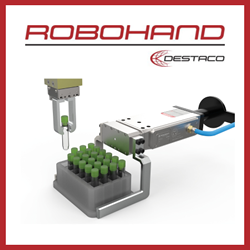
DESTACO - Revolutionizing Industrial Automation

DESTACO - Revolutionizing Industrial Automation

Looking for a reliable solution to enhance your automation process? Look no further than the DESTACO Robohand Grippers. These grippers are designed for the modern world of robotics, offering unparalleled performance and precision. Whether you need to grip fragile items, irregularly shaped objects, or heavy-duty components, the DESTACO Robohand Grippers have got you covered. Their modular design allows for quick and easy customization, ensuring a perfect fit for your application.

Robotics and Automation - Featured Company

ResinDek / Cornerstone Specialty Wood Products

ResinDek / Cornerstone Specialty Wood Products

As the manufacturer of ResinDek® panels, we have been at the forefront of testing and innovating flooring panels for the Material Handling Industry since 1994. In 2007, we began providing ResinDek panels for automated warehouse distribution robots. Much of our initial research and development occurred with Automated Guided Vehicles. In the last decade, we have provided a variety of ResinDek engineered flooring products to numerous Automated Guided Vehicles (AGV) and Autonomous Mobile Robot (AMR) manufacturers for their testing labs. As a result, millions of square feet of ResinDek panels are in service worldwide with robotic traffic in distribution centers, warehouses, microfulfillment centers, and retail environments.