World premier: Elistair tethered drones integrated successfully at airports in activity
Regulations in France forbid drones from flying over airports and airfields. Special permission was nonetheless granted once Elistair was able to prove to the DGAC that safety for people and airport structures was ensured.
Lyon, France, August 23rd, 2016 - Tethered drones created by Elistair, based in Lyon, France, have been authorized by the French civil aviation authority (DGAC) for three interventions at Paris-Charles de Gaulle and Paris - Le Bourget airports for Groupe ADP. This is a first for the airport sector, which offers many opportunities for using drones.
Regulations in France forbid drones from flying over airports and airfields. Special permission was nonetheless granted once Elistair was able to prove to the DGAC that safety for people and airport structures was ensured.
Elistair obtained the necessary authorizations from the DGAC with its tethered stations for innovative drones, SAFE-T and HIGH-T. These solutions enable using drones under optimal safety conditions:
 Drone airspace completely controlled and limited to a range of 50 to 100 meters.
 Direct power supply (with power cable and backup battery), eliminating the risk of crashes due to unexpected empty batteries.
 Secure, high-speed communications via an integrated micro-wire, effectively eliminating interference and jamming.
"These various missions demonstrated the possibility of completely safe interventions, even in complex airport environments, while respecting safety standards required by airports and civil aviation authorities. In addition, the missions highlighted the efficiency of tethered drones with respect to other existing solutions," says Guilhem de Marliave, CEO and co-founder of Elistair.
Integrated with the SAFE-T station, tethered drones by Elistair were used for the following missions:
 Inspection of high walkways (such as for A380 planes) at the Paris-Charles de Gaulle airport: 2 flights of one hour each at an average altitude of 20 meters.
 Calibration of air navigation assistance instruments at the Paris-Le Bourget airport: 7 flights of 2- 3 hours each at an average altitude of 50 to 60 meters.
The drones were fully integrated into the airspace for all missions, with a direct link to the control tower. With safety conditions fully respected, normal airport activity continued uninterrupted during these interventions.
"The airport sector offers interesting opportunities for drones. The numerous applications for which using a drone is more effective than traditional methods include inspecting runways and buildings, surveillance, airborne calibration, assistance with crisis management, tactical domes, and bird scaring. With remarkable benefits in terms of cost, time, and efficiency, tethered drones represent an effective and safe solution to meet many airport needs, while ensuring the safety of space and people," adds Guilhem de Marliave.
About Elistair www.elistair.com
Founded in 2014, Elistair is startup specializing in civilian drones. The company designs, produces, and commercializes tethered drone stations for civil security, intervention teams, security companies, and large industrial companies. Leveraging a patented micro-wire technology, the solutions developed by Elistair are deployed for long duration aerial observation missions and emergency telecommunications missions. The company currently sells its products in Europe, South America, and Asia.
Elistair organized itself and grew quickly, and is now one of the leading tethered drone companies in France, currently expanding internationally. With support from DDrone Invest, an American investment fund, Elistair won the Alliance competition in San Francisco, and was selected by the European Horizon 2020 program.
Featured Product
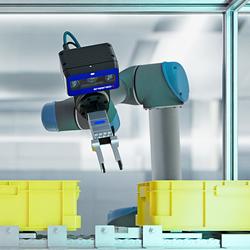
Nion: Next-level time-of-flight
The new Nion 3D camera advances Time-of-Flight (ToF) technology with exceptional resolution, speed, and industrial robustness. Designed for demanding applications such as logistics, warehousing, industrial automation, and robotics, Nion delivers high-resolution depth data with real-time performance for faster, safer, and more flexible operations. At its core is the 1.2-megapixel Time-of-Flight sensor AF0130 from onsemi's Hyperlux ID family, offering up to four times the resolution of conventional VGA-based ToF cameras and significantly higher data density. Active 940-nm laser illumination ensures accurate and stable measurements in low-light conditions, artificial lighting, and even direct sunlight. With an IP67-rated housing, Nion is built for reliable operation in dusty, wet, and thermally challenging industrial environments. A user-friendly API with IDS peak support and compliance with the GigE Vision standard enable fast integration and flexible deployment in high-resolution 3D applications. The Nion 3D camera is now available from IDS Imaging Development Systems.