
Open Source Robotics Foundation Teams Up With Toyota Research Institute for Software Research
Organizations to Focus on Tools for Robotics and Autonomous Vehicles
MOUNTAIN VIEW, Calif.--(BUSINESS WIRE)--The Open Source Robotics Foundation (OSRF) today announced a new engagement by and gift from Toyota Research Institute (TRI). TRI is a research and development enterprise designed to bridge the gap between fundamental research and product development. TRI signed a consulting agreement with the newly-formed Open Source Robotics Corporation, a for-profit subsidiary of OSRF.
In addition, TRI has made a charitable contribution of $1 million to OSRF to support the organization's goals to develop, evangelize and grow the open source robotics community and to support the development of ROS and Gazebo.
"I've witnessed first-hand the value of the Open Source Robotics Foundation. Of the twenty-three teams that competed in the DARPA Robotics Challenge eighteen used ROS and fourteen used Gazebo," according to TRI CEO Gill Pratt. "Through this charitable contribution, TRI will support efforts to grow the capabilities of ROS and Gazebo, not only for TRI, but also for the hundreds of thousands of members of the open source robotics community."
"Our relationship with TRI is an important milestone for the robotics community; a milestone thats been built on the generous efforts of thousands of contributors and hundreds of thousands of users worldwide that helped to make ROS and Gazebo the standards that they are today," according to Brian Gerkey, CEO of Open Source Robotics Foundation. "We look forward to working with TRI to help grow and extend their capabilities and sharing any open source improvements back to the community."
ROS (for "Robot Operating System") is a collection of tools and libraries that simplify the task of creating and programming robotic platforms and applications. Gazebo is a robot simulator with which developers can test concepts in a high-fidelity virtual environment and users can rapidly test algorithms, design robots, and perform regression testing using realistic scenarios. Both ROS and Gazebo are open source software and overseen by OSRF. ROS and Gazebo have both grown to become the de facto programming platform and simulator, respectively, for roboticists all over the world.
OSRF also today announced it has formed a subsidiary company, Open Source Robotics Corporation, which is a taxable subsidiary that supports the goals of its parent, OSRF, and the global open source robotics community. OSRF will continue to create and distribute open source and free-of-charge applications for the robotics community, including ROS and Gazebo.
About The Open Source Robotics Foundation
The Open Source Robotics Foundation (OSRF) is an independent non-profit organization founded by members of the global robotics community. The mission of OSRF is to support the development, distribution, and adoption of open source software for use in robotics research, education, and product development. More information on OSRF is available at www.osrfoundation.org or by following the company on Twitter @OSRFoundation.
Featured Product
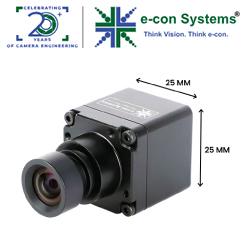
NetraVis - Active Stereo 3D Depth Camera for Accurate Robotic Perception
e-con Systems introduces NetraVis, a 1MP active stereo 3D depth camera designed for high-accuracy robotic perception. Powered by proprietary depth-processing algorithms, NetraVis delivers depth deviation as low as 0.5% at 1 meter, with a sensing range of up to 6 meters and consistent depth performance across reflective and non-reflective surfaces. Its enhanced texture reconstruction enables dense point clouds with greater spatial detail, while a global-shutter RGB sensor and integrated 6-axis IMU provide additional visual and inertial data. An onboard NPU supports AI workloads such as real-time object detection and segmentation, helping reduce host-side processing requirements. With USB 3.0 connectivity and support for Linux, C++, Python, OpenCV, and ROS 2, NetraVis is designed for integration into AMRs, ASRS, and humanoid robots. A GMSL2 variant is also planned for embedded vision platforms, including NVIDIA Jetson.
