Alphapura Robotics' Newest Patent to Redefine and Disrupt the Future of Global Manufacturing
Artificially-Intelligent Recycling Manufacturing Systems (ARMS) Powered by Renewable Energy
A few weeks ago, Alphapura Robotics' Founder, Frederick Janson, originally a research professional at Stanford University, was granted the last of four important sustainability patents by the USPTO, https://patents.justia.com/patent/10611085, which required defending and overcoming years of legal challenges by the pro-fossil fuel Trump administration.
Collectively, this patent family carves out a niche for Alphapura, to be able to offer desktop-sized to home-sized Artificially-Intelligent Recycling Manufacturing Systems (ARMS), https://youtu.be/Ket4CpYSOaM, powered by renewable energy, and also rechargeable, allowing for no-to-low-skilled users to make up to a million different products on the spot out of 100% recyclables, on or off the grid, increasing global access to cheaper, faster, cleaner, more sustainable, and more conveniently-acquired products, to help solve and abate 27 major world issues,https://youtu.be/-4agJnCFXQc.
Alphapura's AIR Collaboration has developed a working desktop-sized prototype capable of transforming recyclables into a million different product types, https://drive.google.com/file/d/1oM-qKMmqZ0kY9---xvQvBdrWkKUTJ5CL/view, and the collaboration is now able to build larger fridge and van-sized units.
Behind the scenes, Alphapura has developed R&D and manufacturing partnerships with a very well known Fortune 150 global leader in robotics, as well as with other vendors, to be able to deliver the remaining sizes of the system, specifically the home size systems, which will be able to 3D print affordable housing out of what is otherwise a major global problem, overflowing meltable plastic.
Furthermore, users of this system can have, save, and do more, and can spend, deplete, and pollute less. Specifically, a case study of Alphapura's first multinational client revealed that ARMS can reduce traditional manufacturing costs by 59.2%, with ARMS able to make paddle boards for $6 each, sold for $1500 each. Alphapura can procure van-sized systems for $25K, which sell for $100K, starting with a prepaid e-commerce and just-in-time e-manufacturing model to start.
Having repeatedly measured a $1-3 trillion market in the US alone, 1/4 of which is found in California, the largest US market - versions of Alphapura's technology have been vetted by the likes of folks from Harvard, MIT, Deloitte USA/UK, NASA, US Military, 3D Systems, Coca Cola, Disney, the Office of the Ruler of Dubai, NBA franchise owners, and/or others.
Simultaneously, Alphapura has been repeatedly recognized, awarded, and selected from the ocean of other startups in Sacramento, California, and they were recently selected by Silicon Valley's Y Combinator, and were most recently picked as one of the five "standout" startups in Sacramento, https://www.comstocksmag.com/web-only/startups-month-where-are-they-now.
Self-funded, and with no debt or loss of equity to date, Alphapura has been increasing meetings with financiers, who have offered different types of opportunities, with the hopes of securing a $250K seed fund to leverage this incredible opportunity. Alphapura has yet to accept terms with any one financing group, and encourages those interested in financing the future of manufacturing to reach out to Frederick Janson at (916) 969-6239 or info@alphapura.com. A pitch deck is available upon request.
Featured Product
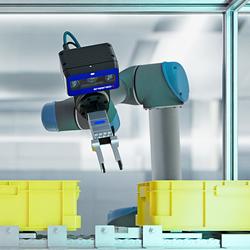
Nion: Next-level time-of-flight
The new Nion 3D camera advances Time-of-Flight (ToF) technology with exceptional resolution, speed, and industrial robustness. Designed for demanding applications such as logistics, warehousing, industrial automation, and robotics, Nion delivers high-resolution depth data with real-time performance for faster, safer, and more flexible operations. At its core is the 1.2-megapixel Time-of-Flight sensor AF0130 from onsemi's Hyperlux ID family, offering up to four times the resolution of conventional VGA-based ToF cameras and significantly higher data density. Active 940-nm laser illumination ensures accurate and stable measurements in low-light conditions, artificial lighting, and even direct sunlight. With an IP67-rated housing, Nion is built for reliable operation in dusty, wet, and thermally challenging industrial environments. A user-friendly API with IDS peak support and compliance with the GigE Vision standard enable fast integration and flexible deployment in high-resolution 3D applications. The Nion 3D camera is now available from IDS Imaging Development Systems.