Purdue Polytechnic to dedicate nation’s largest smart manufacturing ecosystem for engineering technology
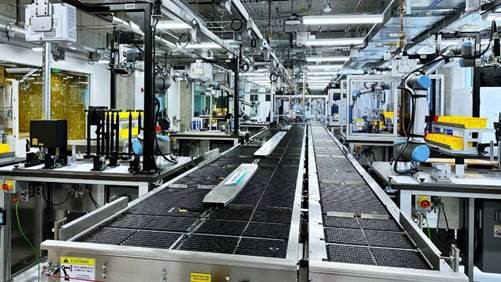
Purdue Polytechnic's Smart Learning Factory, with a finished setup after recent installations.
(Purdue University photo/John O'Malley)
Purdue Polytechnic's School of Engineering Technology (SoET) will dedicate four smart manufacturing facilities, the most expansive learning ecosystem of its kind in the United States.
Located in Dudley and Lambertus Hall on Purdue’s West Lafayette Campus, the facilities will be dedicated on November 30, 2023. The event will be a wider-reaching celebration of Purdue’s new smart manufacturing curriculum, with its goal of revamping engineering technology education and preparing students for industry.
“The Smart Manufacturing Industrial Informatics degree is the cornerstone of our commitment to advancing engineering technology education,” said Daniel Castro, dean of Purdue Polytechnic. “These labs are not just facilities—they are incubators for innovation, where students can synthesize the full spectrum of Industry 4.0 technologies with hands-on problem-solving.”
Smart manufacturing and future industry
The facilities are the final component in establishing Purdue Polytechnic’s new Smart Manufacturing Industrial Informatics degree. This interdisciplinary program synergizes science, engineering, information systems and computing, focusing on manufacturing's next evolutionary step called Industry 4.0. The new facility ecosystem also has wide-ranging applications, opening up potential curriculum expansion for all other engineering technology degrees.
Smart manufacturing at Purdue defines Industry 4.0 as the integration of information technology and operational technology, paired with a human-centric focus on advanced automation such as AI and machine learning.
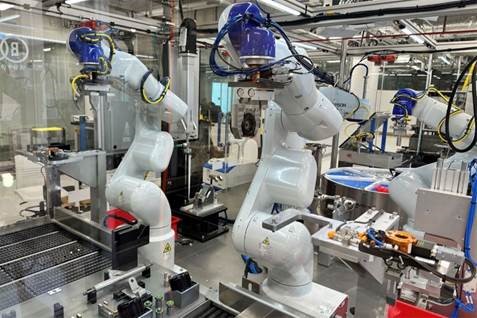
Robotic devices in the Smart Learning Factory, provided by BBS Automation. BBS helps industry develop automated processes and lower energy costs.
(Purdue University photo/John O'Malley)
As companies implement vital new technology in their processes, more than half of industry leaders worry that their factory workforce is unprepared to adapt. Top industry voices say that up to 53% of job openings in manufacturing could lie vacant. Without swift action, that means that 2.1 million manufacturing jobs could go unfilled by 2030.
“Our smart manufacturing labs embody Purdue Polytechnic's proactive strategy to bridge the gap between academia and industry,” affirms Ken Burbank, professor and head of SoET. “This is where we train future professionals and innovators, ensuring they are not just ready to enter the workforce but equipped to lead it.”
Student-driven learning methods
The facilities are Purdue's answer to an industry in transformation, tailor-made to close the workforce’s skills gap. By integrating experiential learning with sophisticated technology, the new curriculum is designed to propel Purdue graduates to the forefront of the manufacturing sector.
The labs boast a suite of state-of-the-art technologies, from AI and robotics to cloud computing, providing a comprehensive curriculum that mirrors the complex systems used in modern manufacturing settings. Students have the opportunity to use real industry equipment and technology firsthand, provided by industry leaders like Microsoft, Accenture, Caterpillar, Fortinet, Endress+Hauser and more.
“AI, data and other digital technologies are becoming the steam engines of the factories of the future,” said Aaron Saint, who leads Accenture’s digital engineering and manufacturing service called Industry X in North America. “They herald massive change for the way people work on and around the shop floor, as well as how production lines are set up, and production facilities are run. The Smart Factory at Purdue that Accenture supports will give students the opportunity to work in this future already today.”
“Fortinet is pleased to partner with Purdue to increase awareness of [operational technology (OT)] cybersecurity career pathways and develop OT security talent at both graduate and undergraduate levels,” said Fortinet’s Richard Springer, Director of OT Solutions. “Fortinet has donated hardware and software for use in the smart manufacturing laboratories, helping provide students with real-world, hands-on experiences to further address the industry’s skills gap by helping build the workforce of the future.”
Purdue Polytechnic's collaboration with industrial heavyweights ensures that students learn on the cutting edge, ready to translate their education into tangible progress. From prototyping to market-ready product development, Purdue students are empowered to turn concepts into reality, ushering in a new era of manufacturing proficiency.
About Purdue Polytechnic's School of Engineering Technology
Blending theory with practice, Purdue Polytechnic's SoET remains a beacon of innovative technical education, preparing students for the dynamic and interconnected world of modern industry.
For More Information: Explore the transformational smart manufacturing ecosystem here, and learn about Purdue Polytechnic's educational and research offerings in manufacturing here.
Comments (0)
This post does not have any comments. Be the first to leave a comment below.
Featured Product