Bedrock is taking advantage of the dramatic accessibility of GPUs and frameworks for scaled data access and training, combining it with our unique understanding of how to build and create autonomy solutions quickly and efficiently.
 Physical AI and Autonomy in the Construction Industry
Q&A with Tom Eliaz, VP of Engineering | Bedrock Robotics
Tell us about yourself and what led to the founding of Bedrock Robotics.
I’m a co-founder and Vice President of Engineering at Bedrock Robotics, overseeing all aspects of infrastructure, data, and applications. Along with our other three co-founders, who are former Waymo engineering leaders, we’ve set out to solve America’s construction crisis by transforming existing construction equipment into fully autonomous machines. We're developing technology that will bring autonomy directly to job sites, helping address the gap of 500,000 open construction jobs and move critical infrastructure projects forward.
I’m driven by a love for bringing engineering teams together to solve real problems for customers. At Segment, I built out the NYC engineering office, and developed computational products that became a key part of their $3.2B acquisition by Twilio. At Twilio, I was a Vice President of Engineering, leading both new and established products. Prior to this, I led Anki’s high-scale robotics cloud, which is where I met our CEO, Boris Sofman. At Anki, we cultivated an environment where people came to work joyfully, collaboratively, and without ego – everyone was passionate about the work and left each day energized. At Bedrock Robotics, we believe we can build the same culture while doing what we love. It’s exciting to work at the intersection of the physical and the digital, and we saw a great opportunity to apply our team’s past experience in autonomous technology to fill a critical labor gap in the construction industry.
Why do you believe now is the right time to introduce autonomy to construction?
We’re in an era where we need to build faster than ever. From housing to data centers, factories, and energy infrastructure, autonomous construction isn't just an innovation – it's an economic necessity. Currently, over 500,000 construction positions sit vacant while 40% of experienced workers approach retirement, creating a perfect storm where vital projects get abandoned, reasonable timelines turn into multi-year projects, and costs inflate to prohibitive levels. This also goes beyond just construction. The soaring demand for infrastructure, paired with a shrinking construction workforce, has created a pressing economic bottleneck. When we can’t build what modern society requires, we find ourselves limited in our capacity for innovation, community growth, and overall progress. That’s why our team decided to focus on this challenge and apply advanced automation to meet the demand.
Previous attempts at this type of advancement in construction fell flat because the path to get there with autonomy was unclear, and access to infrastructure and scaled frameworks was lacking. With the rapid evolution of AI in the past few years, we’ve finally found ourselves at a place where this is possible. Bedrock is taking advantage of the dramatic accessibility of GPUs and frameworks for scaled data access and training, combining it with our unique understanding of how to build and create autonomy solutions quickly and efficiently.
What are the biggest barriers to the adoption of autonomy in the construction industry?
We’ve seen that enthusiasm from key industry players has grown significantly, but a few barriers to adoption have persisted in the industry for decades. Factors such as technical complexity, high cost of equipment overhauls, and insufficient autonomy performance have hindered the widespread adoption of automation in the past.
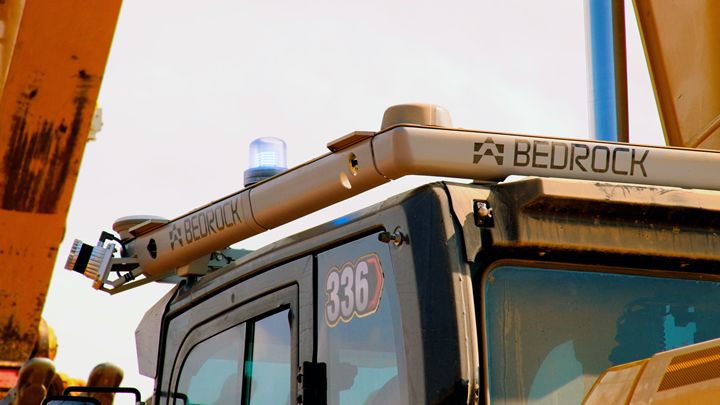
We're developing the Bedrock Operator to directly address these challenges, which will transform existing construction equipment into autonomous machines designed to operate with enhanced precision and safety. Our approach not only makes adopting autonomous technology seamless and approachable, but it’s significantly more cost-effective. Rather than requiring contractors to purchase million-dollar autonomous equipment, we’ve engineered a same-day, reversible retrofit kit that mounts to existing fleets without permanent modifications.
Additionally, we're ensuring real-world readiness through extensive field testing across diverse construction environments in California, Arizona, Texas, and Arkansas. Construction happens in unpredictable environments, so we train large-scale end-to-end models across thousands of hours of operation across varied project conditions. This field-testing approach is helping us develop technology hand-in-hand with contractors and their skilled crews, ensuring it performs reliably in real-world construction scenarios.
How is physical AI the next frontier for industries like construction?
We’ve seen how autonomy and AI have transformed other physical industries like logistics, manufacturing, and mobility. Now, we see a great opportunity for construction as the next sector for transformation. In addition to the high demand for development, construction also has historically high injury and accident rates. According to the Bureau of Labor Statistics, construction accounts for one in five workplace deaths in America. We believe that autonomous operations can, and should, address this. Our technology uses comprehensive 360-degree perception and multiple sensor types that can operate effectively in hazardous conditions. The result is machines that can operate safely around workers and coordinate with other equipment, all while navigating complex job site conditions. We also see a great opportunity for autonomous operation to support understaffed construction crews, which are already stretched thin with ambitious timelines. By handling overnight and weekend shifts, this technology could help skilled operators maintain sustainable careers without the burnout that drives so many from the industry.
How is autonomous equipment accelerating data center construction to power the generative AI boom?
Major tech companies are rapidly building new data centers across the country and are continuing to announce new projects to power the demand for AI. Microsoft alone has committed $80 billion to data center construction in 2025, and AWS, GCP, and others have announced similarly ambitious plans. These projects require massive earthwork, removing soil across several acres of land for foundations, cooling systems, and power infrastructure. The only solution to effectively keep up with this growing backlog is not just greater efficiency – it’s better technology.
Our autonomous technology will directly accelerate these projects by enabling 24/7 site preparation and excavation. While construction crews work standard shifts and focus on more complex and nuanced tasks, our autonomous machines will handle the repetitive process of removing soil through nights and weekends, potentially cutting months off the earthwork phase for these projects.
The Bedrock Operator achieves this through systems that scan and map the environment using multiple sensor types, generate task plans that update every few seconds as conditions change, and execute those plans with centimeter-level precision. This means contractors can run three shifts of earthwork without tripling their workforce or compromising wellbeing, compress project schedules, and deliver these critical facilities faster – getting data centers online to meet surging AI compute demands.
What key takeaways from leading engineering at companies like Segment and Anki are you applying to Bedrock?
I’m grateful to have led passionate teams at both Segment and Anki, where people felt inspired to embrace challenges, no matter how complex. We started Bedrock with well-defined long-term goals, with many unsolved challenges to get there, and expecting a multi-domain, multi-year sustained effort. Since the start, we have focused on documenting our long and medium-term milestones, and have used these as the matrix aligning all our workstreams. Our focus on milestones that we continually define and refine has helped us move quickly by providing autonomy to many teams as we execute short, medium, and long-term work simultaneously.
I’m excited about the work we’re doing for the construction industry and beyond. I’m also focused on cultivating an inspirational environment of kindness and collaboration where people feel excited to be part of this company, and teams feel empowered to do their best work. One of the best things we brought as a founding team was the knowledge that we couldn't do it alone, and in many cases, who to ask for help. We’re now bringing this mindset to our leadership at Bedrock, building an environment where people are driven by the eagerness to do good and to do it creatively and collaboratively.
Can you share any lessons you have learned from scaling AI projects to unstructured job sites?
Data collection and rapid iteration on models are a cornerstone of Bedrock’s ability to solve autonomy challenges in semi-structured construction sites. To achieve this, we focus on our ability to gather real-world data, simulate environments, quickly build and train on large datasets, and test the results.
One key lesson learned is: To create the capability to rapidly iterate on models adapting to new information from the field, and to continue to scale this capacity over time, we need to effectively balance short, medium, and long-term infrastructure work from the outset. With this balanced investment, we’re able to scale model iteration and avoid major delays caused by large infrastructure changes impacting model engineers and our larger engineering team.
Our plan was to build a few key abstraction layers early that are the foundation of the architecture: Data APIs and compute frameworks. We invested early in APIs that separated data storage from data-set specification and data consumption, and slowly expanded our data-set management capabilities and data encoding optimizations. We also used frameworks like Ray to help us enable local, single-node, and multi-node training without major disruption to engineers. We avoided platforms that locked us into specific work deployment models that weren’t nimble or adaptable.
These early investments in lightweight abstractions and frameworks that matched our need for rapid experimentation were successful. We’ve avoided a number of pitfalls in data and computation that we saw as potential issues early on, and we’ve achieved a rapid pace of model iteration that adapts to the complexities of our unstructured job sites.
Look into the future a few years, where do you see autonomy in construction?
I'm very optimistic about the continual transformation of our country through autonomous development. At Bedrock, we envision a future where ambitious teams can tackle major infrastructure projects, housing that becomes affordable through accelerated and predictable construction timelines, and critical infrastructure that's completed on schedule through continuous 24/7 operations that maintain the highest safety standards.
In parallel, I believe the future of autonomy brings opportunities for skilled operators to focus on complex problem-solving and oversight while autonomous systems handle repetitive, dangerous tasks. This isn't about replacing workers – it's about amplifying their capabilities and creating safer, more sustainable careers in construction.
We're developing this technology for the industry to enable a construction ecosystem where building capacity finally matches societal demand, unlocking the infrastructure development that modern economic growth requires.
The content & opinions in this article are the author’s and do not necessarily represent the views of RoboticsTomorrow
Featured Product