World's First Dual Channel Brushless DC Motor Controller Targets Small Electric Vehicles and Robotics
The controller also includes protection against overheat, stall, and short circuits.
Scottsdale, AZ, August 24, 2011 - Roboteq, Inc (www.roboteq.com) introduces the HBL2350, an intelligent controller capable of simultaneously driving two brushless DC motor up to 75Amps each at up to 50V.
Because they have no brushes, Brushless motors operate more quietly and have a longer life than equivalent Brushed motors. Roboteq's HBL2350 is the world's first dual channel, high current Brushless motor controller, allowing users to implement 2-wheel drive small electric vehicles, Automatic Guided Vehicles (AGVs), balancing scooters, or any other high power brushless motor control application.
The controller accepts commands from either analog pedal/joystick, standard R/C radio for simple remote controlled robot applications, USB or RS232 interface. Using the serial port, the HBL2350 can be used to design fully or semi-autonomous robots by connecting it to single board computers, wireless modems or WiFi adapters.
The HBL2350 incorporates a Basic Language Interpreter capable of executing over 50,000 Basic instructions per second. This feature can be used to write powerful scripts for adding custom functions, or for developing automated systems without the need for an external PLC or microcomputer.
The controller's two channels can be operated independently or combined to set the direction and rotation of a vehicle by coordinating the motors on each side (tank-like steering). The motors may be operated in open or closed loop speed or position modes with a 1 kHz update rate. The HBL2350 can use the motor's hall sensors or optical encoders to measure speed and travelled distance with high accuracy.
The HBL2350 features intelligent current sensing that will automatically limit each of the power outputs to 75A in all load conditions. The controller also includes protection against overheat, stall, and short circuits.
The controller includes up to 11 analog, 19 digital and 6 pulse inputs. Eight 1A digital outputs are provided for activating lights, valves, brakes or other accessories. The controller's operation can be optimized using nearly 80 configurable parameters, such as programmable acceleration or deceleration, amps limits, operating voltage range, use of I/O, and more.
A free PC utility is available for configuring, tuning and exercising the motor. The controller can be reprogrammed in the field with the latest features by downloading new operating firmware from Roboteq's web site.
The HBL2350 is built into a compact 9.0"L x 5.5"W x 1.6"H (228mm x 140mm x 40mm), robust extruded aluminum case, which also serves as a heat sink for its output power stage. The large fin area ensures sufficient heat dissipation for operation without a fan in most applications.
The HBL2350 is available now to customers worldwide at $625 in single quantities, complete with cable and PC-based configuration software. A simpler version with no encoder input and fewer I/O is available for $495. Product information and software can be downloaded from the company's web site at www.roboteq.com.
About Roboteq
Founded in 2001 by experts in embedded computing and power electronics, Roboteq's mission is to develop products and technologies that allow novices and professionals alike to build innovative, flexible and affordable mobile robots. Roboteq controllers are now used in over 2000 original robot designs around the world.
Featured Product
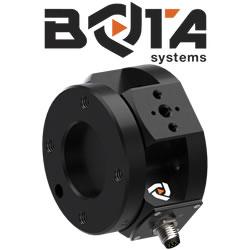
Bota Systems - The SensONE 6-axis force torque sensor for robots
Our Bota Systems force torque sensors, like the SensONE, are designed for collaborative and industrial robots. It enables human machine interaction, provides force, vision and inertia data and offers "plug and work" foll all platforms. The compact design is dustproof and water-resistant. The ISO 9409-1-50-4-M6 mounting flange makes integrating the SensONE sensor with robots extremely easy.
No adapter is needed, only fasteners! The SensONE sensor is a one of its kind product and the best solution for force feedback applications and collaborative robots at its price. The SensONE is available in two communication options and includes software integration with TwinCAT, ROS, LabVIEW and MATLAB®.