
Stratasys Joins PTC partneradvantage program to INCREASE ACCESSiBILITY and enhance Design for additive manufacturing
PTC technology solutions help customers transform the way they create, operate and service products across the entire product lifecycle – from conception and design to sourcing and service.
Minneapolis, MN; Rehovot, Israel - Nov. 25, 2014 - Stratasys Ltd. (Nasdaq:SSYS), a leading global provider of 3D printing and additive manufacturing solutions, today announced the company has joined the PTC PartnerAdvantage Program at the Platinum Tier to create integrated, collaborative solutions that enable PTC Creo design software users to optimize their designs and streamline workflows for Stratasys 3D printing solutions.
PTC Inc. enables manufacturers to achieve a sustained product and service advantage. PTC technology solutions help customers transform the way they create, operate and service products across the entire product lifecycle - from conception and design to sourcing and service. The PTC PartnerAdvantage Program is PTCs technology partner program for complementary hardware and software companies.
Stratasys and PTC share a vision of enabling optimized design for additive manufacturing and helping enterprise customers reap the benefits of production using additive manufacturing. The two companies will participate in joint technical, educational and go-to-market activities that will increase the synergy and accessibility between PTCs design software and Stratasys complete line of 3D printing solutions. Key customer use cases include prototyping, manufacturing tools, temporary parts, and end-use parts. Designers, engineers, and manufacturers may benefit from efficient, accurate and user-friendly design-to-print workflows, and be able to create lighter and stronger products that have been designed and optimized with additive manufacturing in mind.
"PTC is excited about collaborating with Stratasys to help transform the way our joint customers create great products," said Michael Campbell, Executive Vice President - CAD Segment, PTC Inc. "Our shared vision will not only support our customers as they embrace additive manufacturing but also allow them to exploit new technologies. Collaborating with Stratasys allows us to accelerate our ability to help customers create stronger, lighter, more differentiated products by truly optimizing their designs for 3D printing."
"Working closely with our customers has shown us that there is a gap between design software programs and additive manufacturing technologies, which we are now bridging through key industry partnerships," said Dan Yalon, Executive VP of Business Development, Marketing and Vertical Solutions at Stratasys. "We are therefore pleased to announce this collaboration between two industry leaders, which is designed to create a streamlined experience between PTC and Stratasys solutions. The tools and knowledge we will provide are aimed to allow our customers to save significant time, effort and resources throughout their design and manufacturing cycle and improve the quality of the final products."
Featured Product
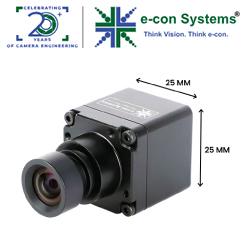
NetraVis - Active Stereo 3D Depth Camera for Accurate Robotic Perception
e-con Systems introduces NetraVis, a 1MP active stereo 3D depth camera designed for high-accuracy robotic perception. Powered by proprietary depth-processing algorithms, NetraVis delivers depth deviation as low as 0.5% at 1 meter, with a sensing range of up to 6 meters and consistent depth performance across reflective and non-reflective surfaces. Its enhanced texture reconstruction enables dense point clouds with greater spatial detail, while a global-shutter RGB sensor and integrated 6-axis IMU provide additional visual and inertial data. An onboard NPU supports AI workloads such as real-time object detection and segmentation, helping reduce host-side processing requirements. With USB 3.0 connectivity and support for Linux, C++, Python, OpenCV, and ROS 2, NetraVis is designed for integration into AMRs, ASRS, and humanoid robots. A GMSL2 variant is also planned for embedded vision platforms, including NVIDIA Jetson.
