PCB Line Spacing: A Comprehensive Breakdown for High Voltage Applications
As PCBs become more complicated, more precise measurements and spacing are required. This article explains PCB line spacing, tracing, clearance, and creepage.
San Francisco Circuits has released a new in-depth article on PCB Line Spacing for high voltage applications.
PCB line spacing is critical for both safety and function in high voltage circuitry. Traces, which are conductive connections between different components on a PCB, must adhere to specific spacing standards to prevent electrical shorts and maintain circuit integrity.
Proper line spacing can prevent issues like arcing by following established safety standards. Additionally, clearance and creepage distances are crucial to avoid electrical faults in high voltage circuits.
As technology advances, so do the standards and tools available for PCB design. Accurate line spacing is crucial, especially in complex designs used in medical devices, industrial equipment, and power electronics.
Read more about the principles of PCB Line Spacing in high voltage applications on San Francisco Circuits' website.
About San Francisco Circuits
San Francisco Circuits is a leader in PCB fabrication and PCB assembly. From simple to complex PCBs-SFC produces elaborate and high-quality PCBs in both prototype and production quantities.
If you are looking to discuss a PCB project of any scope, reach out to SFC's team of experts via their website at www.SFCircuits.com or by phone at 800.SFC.5143.
Featured Product
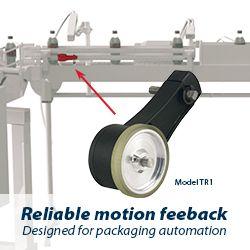
Model TR1 Tru-Trac
The Model TR1 Tru-Trac® linear measurement solution is a versatile option for tracking velocity, position, or distance over a wide variety of surfaces. An integrated encoder, measuring wheel, and spring-loaded torsion arm in one, compact unit, the Model TR1 is easy to install. The spring-loaded torsion arm offers adjustable torsion load, allowing the Model TR1 to be mounted in almost any orientation - even upside-down. The threaded shaft on the pivot axis is field reversible, providing mounting access from either side. With operating speeds up to 3000 feet per minute, a wide variety of configuration options - including multiple wheel material options - and a housing made from a durable, conductive composite material that minimizes static buildup, the Model TR1 Tru-Trac® is the ideal solution for countless applications.