Robotic Trends in 2025: Innovations Transforming Industries
The robotics landscape in 2025 is an example of how innovation continues redefining industries. Robotics together with technologies such as Artificial Intelligence or the Digital Twin, acts as a driving force for cost reduction, operational efficiency and competitive positioning. This article delves into the main trends of robotics in 2025, showing its potential to revolutionise various sectors.
1ï¸âƒ£ARTIFICIAL INTELLIGENCE AND MACHINE LEARNING
ðŸ"ºEnhanced Autonomy: Robots are performing complex tasks like advanced planning, pattern recognition, and fault prediction.
ðŸ"ºReal-Time Adaptation: AI enables robots to respond dynamically to environmental changes, enhancing their functionality.
ðŸ"ºImproved Connectivity: Human-robot interaction is evolving with specialized AI that facilitates seamless communication and task execution.
By leveraging AI, industries can deploy robots that not only perform tasks efficiently but also learn and improve in real time.
2ï¸âƒ£COLLABORATIVE ROBOTS (COBOTS): REDEFINING WORKFORCE DYNAMICS
Collaborative robots or cobots are valuable because of their ability to interact directly with humans, facilitating their use in small businesses and dynamic environments. Their flexibility, precision and adaptability is transforming work dynamics, reducing costs and increasing efficiency in various industries.
By 2025, these robots are expected to evolve to enhanced capabilities:
ðŸ"ºIncreased autonomy: Integrating more advanced software and sensors, cobots can perform more complex tasks and adapt to changes in real time independently
ðŸ"ºEase of use: Simplified programming allows non-experts to operate cobots, expanding their accessibility for small and medium-sized enterprises (SMEs) to have access to these technologies.
ðŸ"ºIncreased safety: technological developments and built-in safety features ensure secure interaction with human operators, even in high-risk environments.
3ï¸âƒ£MOBILE MANIPULATORS: A GAME-CHANGER IN ROBOTICS
Autonomous Mobile Manipulation will still be one of the most valuable trends in 2025 thanks to the possibilities offered by the combination of a mobile platform and a manipulator arm.
Applications of Mobile Manipulators:
ðŸ"ºTransporting and handling objects in dynamic industrial environments.
ðŸ"ºPerforming repetitive tasks like assembly, bolting, or packaging.
ðŸ"ºImproving operational efficiency in industries that require mobility and precision.
ðŸ"ºWith increased adoption across enterprises, mobile manipulators are proving invaluable for enhancing productivity and reducing operational costs.
4ï¸âƒ£DIGITAL TWIN TECHNOLOGY: OPTIMIZING ROBOTICS THROUGH VIRTUAL SIMULATIONS
Digital Twin technology creates virtual replicas of robotic systems, enabling real-time analysis and optimization without physical risks.
Advantages of Digital Twins in Robotics:
ðŸ"ºSimulated Testing: Test scenarios virtually to identify potential failures.
ðŸ"ºPerformance Optimization: Analyze and refine robot functionality before deployment.
ðŸ"ºMaintenance Efficiency: Predict and prevent mechanical failures, reducing downtime.
This technology accelerates innovation while ensuring cost-effective and risk-free development.
5ï¸âƒ£HUMANOID ROBOTS: THEIR CONTRIBUTION TO SERVICE ROBOTICS
Humanoid robots are becoming increasingly prevalent in sectors such as healthcare, personal assistance, and critical environment exploration.
ðŸ"ºImproved Mobility: Enhanced dexterity allows humanoids to navigate complex environments.
ðŸ"ºVersatile Applications: humanoids are already being used in tasks ranging from social and health care to industrial tasks such as the inspection of hazardous areas.
ðŸ"ºAdvancing AI Integration: Customizable AI capabilities make humanoids adaptive to specific needs.
As investments in humanoid robotics grow, their practical applications continue to expand.
6ï¸âƒ£CUSTOMISATION AND MODULARITY IN ROBOTICS
In 2025, the demand for customized robotic solutions is on the rise. Industries are opting for modular designs to meet specific requirements.
ðŸ"ºModular designs: Robots with interchangeable components or modules like RB-THERON that adapt to different tasks according to the user's needs.
ðŸ"ºIndustry-specific solutions: From manufacturing to inspection and maintenance, tailored robots address the unique needs of different sectors.
ðŸ"ºAdaptable interface: Robots can be easily configured through accessible software platforms such as ROS, in the case of Robotnik.
7ï¸âƒ£SUSTAINABLE ROBOTICS AND ENERGY EFFICIENCY
Sustainability is a core focus in robotics development for 2025. Robots are now being designed with eco-friendly materials and energy-efficient systems.
ðŸ"ºRecyclable Materials: Robots constructed with sustainable materials reduce environmental impact.
ðŸ"ºEnergy Optimization: Innovations in battery technology and power management ensure energy efficiency.
ðŸ"ºGreen Manufacturing Practices: Robotics manufacturers are adopting processes that prioritize sustainability.
This trend aligns with the global push towards reducing carbon footprints in technology.
Featured Product
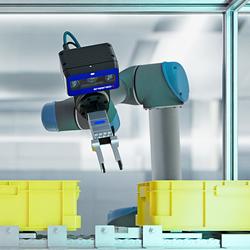
Nion: Next-level time-of-flight
The new Nion 3D camera advances Time-of-Flight (ToF) technology with exceptional resolution, speed, and industrial robustness. Designed for demanding applications such as logistics, warehousing, industrial automation, and robotics, Nion delivers high-resolution depth data with real-time performance for faster, safer, and more flexible operations. At its core is the 1.2-megapixel Time-of-Flight sensor AF0130 from onsemi's Hyperlux ID family, offering up to four times the resolution of conventional VGA-based ToF cameras and significantly higher data density. Active 940-nm laser illumination ensures accurate and stable measurements in low-light conditions, artificial lighting, and even direct sunlight. With an IP67-rated housing, Nion is built for reliable operation in dusty, wet, and thermally challenging industrial environments. A user-friendly API with IDS peak support and compliance with the GigE Vision standard enable fast integration and flexible deployment in high-resolution 3D applications. The Nion 3D camera is now available from IDS Imaging Development Systems.