Equipped with advanced mapping, multi-sensor vision and zone-based safety, the system navigates real-job sites with confidence—handling up to 6,000 sq ft/hour and supporting pressure-wash rigs up to 12 GPM and 4,500 PSI.
 Facility Maintenance: Lavo Bot AI and NVIDIA Bring Autonomy to Exterior Surface Cleaning
Case Study from | Lucid Bots
A New Era of Autonomous Cleaning: Lavo AI
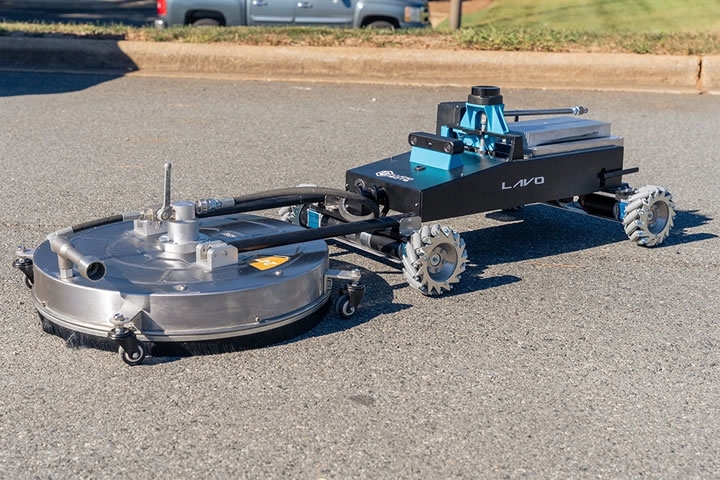
Lavo Bot AI brings enterprise-grade autonomy to one of the most demanding exterior maintenance tasks. Using Click-and-Clean™ job templates powered by Lucid OS™, operators can set up, save, and repeat complex cleaning routes with only a few taps, eliminating hours of manual prep work.
With advanced mapping, full-environment sensing, and powered by NVIDIA edge compute, Lavo Bot AI navigates real facilities with confidence and delivers consistent, high-quality cleaning at scale. This is autonomy designed for real job sites, not just controlled environments.
The system can clean up to 6,000 square feet per hour and integrates with commercial pressure washing rigs up to 20 GPM and 4,500 PSI. Early adopters are already seeing what it means to unlock more output without adding more headcount.
Why it matters
Facility teams are being asked to do more with fewer people as the United States janitorial and building maintenance market reaches ~$108B. Labor shortages continue to grow, service expectations are rising, and operators are under pressure to maintain cleaner, safer exterior environments while also reducing costs. Within this market, exterior surface cleaning alone represents $15 to $22B dollars in recurring annual work, most of which is still performed manually.
Despite the size of the industry, autonomous systems account for well under one percent of all surface cleaning operations today. Most facilities rely on slow and physically demanding manual workflows that limit throughput and make scheduling unpredictable. Lavo Bot AI gives operators an immediate path to higher productivity, consistent quality, and more reliable service delivery. The robot augments crews rather than replacing them and allows existing teams to cover significantly more ground with far less strain, making exterior maintenance more scalable and cost effective.
How It Works
Lavo Bot AI uses the latest NVIDIA edge compute platform to power its autonomy, vision systems, and mapping intelligence. These capabilities allow the robot to move safely through real-world environments and produce enterprise-grade results.
Key capabilities include:
- Autonomy that lasts. Operators can save job areas and rerun them with precise route memory on a recurring schedule.
- Safety for active job sites. Multi-sensor vision systems and zone-based geofencing support safe operation around people and equipment.
- Purpose-built durability. The robot can handle long hose runs and challenging outdoor conditions including grime, gum, grease, and inconsistent surface textures.
Customer perspective
"You recover the investment in just a couple of months," said Francisco Oliveras, owner of PWR Wash PR. "With this approach, you can reduce operating expenses by 40% or more."
The content & opinions in this article are the author’s and do not necessarily represent the views of RoboticsTomorrow
Featured Product