Introducing Chef's Pat-Down Capability for Enhanced Meal Presentation and Sealing
The capability improves meal presentation, reduces tray-sealing issues, and minimizes food waste while allowing manufacturers to reduce labor costs.
Chef Robotics, a leader in AI-enabled robotics for the food industry, today announced its new pat-down capability. Chef robots can now "pat down" or "tamp down" ingredients inside prepared meal trays before sealing, enabling food manufacturers to automate a labor-intensive spreading and flattening task. The capability improves meal presentation, reduces tray-sealing issues, and minimizes food waste while allowing manufacturers to reduce labor costs.
Food companies are facing growing pressure to deliver more packaged meals while maintaining consistency, safety, and visual appeal—all while navigating labor shortages and turnover rates exceeding 150% annually. When workers deposit ingredients into meal trays, the ingredients naturally settle in the center, creating an uneven, bulging appearance. This leads to spillage during tray sealing, limited space for other ingredients, and compromised product aesthetics. To achieve uniform coverage before sealing, manufacturers often rely on line workers to manually flatten food inside each tray—a repetitive task that leads to fatigue, repetitive stress injuries, and higher labor costs.
Chef's new pat-down capability fully automates meal flattening tasks using vibration technology in the end effector along with a flat, cross-slotted utensil. This new utensil is interchangeable with Chef's depositing utensils and features a cleanable, rounded-edge design that meets food safety standards and cleaning protocols. The solution employs AI-powered computer vision software to detect and track trays on the conveyor in real time, understanding their position and orientation. This detection capability enables the robots to handle variations in tray positions, line stoppages, and speed changes that traditional automation cannot manage.
For high-volume operations, the pat-down capability integrates with Chef's robot-to-robot (R2R) coordination system, enabling multiple robots to coordinate and distribute tasks by alternating trays for increased throughput. Production lines can also use robots for both meal assembly and pat-down operations simultaneously, with one robot depositing ingredients while another flattens meals.
The pat-down capability eliminates a strenuous, repetitive task, freeing up workers for higher-value tasks while reducing overall production costs and preventing repetitive stress injuries. Beyond labor cost reduction, the solution addresses downstream operational challenges such as spillage during sealing, machine downtime, rejected trays, and food waste.
Some Chef customers have already deployed the pat-down capability on their production lines, ensuring consistent presentation and tray sealing for frozen meals such as mac and cheese. The capability is now widely available to food manufacturers in the U.S., Canada, and the UK. As part of Chef's robotics-as-a-service (RaaS) pricing model, the capability requires no upfront capital investment.
About Chef Robotics
Chef is the first company to have commercialized a scalable AI-driven food robotics solution. With over 79 million servings made in production, Chef leverages ChefOS, an AI platform for food manipulation, to offer a Robotics-as-a-Service solution that helps industry-leading food companies increase production volume and meet demand. Headquartered in San Francisco, CA, Chef aims to empower humans to do what humans do best by accelerating the advent of intelligent machines. Visit https://chefrobotics.ai to learn more.
Featured Product
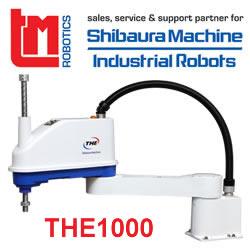
TM Robotics - Shibaura Machine THE SCARA range
The THE range from Shibaura Machine is an extensive line up of SCARA robots. Available in four arm lengths THE400 (400mm), THE600 (600mm) and the most recent THE800 (800mm) and THE1000 (1000mm), this range is suitable for assembly, handling, inspection and pick and place processes in varied industrial applications. The THE1000 boasts a 20kg payload capacity and an impressive 0.44 second cycle time, providing high speeds for processes with large components. In fact, the range has been recognised for as the price-to-performance leader compared to other SCARA models in its price range due to its impressive speed versus payload capacity.