Microscan Announces AutoVISION 2.0, the Next Generation of Simplified Machine Vision Software
Microscan announces the availability of AutoVISIONâ„¢ 2.0, its latest generation of machine vision software. AutoVISIONâ„¢ 2.0 combines a simplified user interface with a powerful toolset for inspection, error proofing, and identification applications.
RENTON, WA, January 17, 2012 - Microscan, a global technology leader in barcode, machine vision and lighting solutions, announces the availability of AutoVISIONâ„¢ 2.0, its latest generation of machine vision software. AutoVISIONâ„¢ 2.0 combines a simplified user interface with a powerful toolset for inspection, error proofing, and identification applications.
Microscan first introduced AutoVISIONâ„¢ software in 2011, and it has since been widely adopted by manufacturers looking to implement machine vision based systems with minimal time, effort, and training. AutoVISIONâ„¢ 2.0 maintains the same intuitive interface as the initial AutoVISION release, but provides additional capabilities, including Verification and OCV (Optical Character Verification) Tools to validate print quality, a Logic Tool for building pass/fail criteria, and support for automated job changeover. AutoVISIONâ„¢ 2.0 also features Microscan LINK for easy connectivity to PLCs and other industrial control systems.
AutoVISIONâ„¢ 2.0 supports Microscan's Vision MINI and Vision HAWK Smart Cameras. With compact, fully integrated or C-Mount designs, the hardware line offers a range of solutions for easy integration into systems or existing assembly lines. The AutoVISIONâ„¢ suite of products provides an ideal solution for manufacturers who need to read barcodes, but want to add additional inspection capabilities to this process with a single hardware device. For more complex applications, AutoVISIONâ„¢ can be upgraded to Microscan's advanced Visionscape® platform. This scalable format protects the customer's time, effort and capital investment in their system because it is uniquely expandable to handle cases where requirements extend beyond the scope of original application. In addition, the common software architecture across Microscan's hardware line enables portability from smart cameras to PC-based systems.
For more information on Microscan's new AutoVISIONâ„¢ 2.0 machine vision software, visit www.microscan.com.
About Microscan
Microscan is a global leader in technology for precision data acquisition and control solutions serving a wide range of automation and OEM applications. Founded in 1982, Microscan has a strong history of technology innovation that includes the invention of the first laser diode barcode scanner and the 2D symbology, Data Matrix. Today, Microscan remains a technology leader in automatic identification and machine vision with extensive solutions for ID tracking, traceability and inspection ranging from basic barcode reading up to complex machine vision inspection, identification, and measurement.
As an ISO 9001:2008 certified company recognized for quality leadership in the U.S., Microscan is known and trusted by customers worldwide as a provider of quality, high precision products. Microscan is a Spectris company.
Microscan Contact
Corporate Headquarters, U.S.
Cathy McBeth, Global Commercial Marketing Manager
+1 425-203-4972; cmcbeth@microscan.com
Featured Product
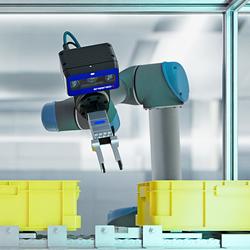
Nion: Next-level time-of-flight
The new Nion 3D camera advances Time-of-Flight (ToF) technology with exceptional resolution, speed, and industrial robustness. Designed for demanding applications such as logistics, warehousing, industrial automation, and robotics, Nion delivers high-resolution depth data with real-time performance for faster, safer, and more flexible operations. At its core is the 1.2-megapixel Time-of-Flight sensor AF0130 from onsemi's Hyperlux ID family, offering up to four times the resolution of conventional VGA-based ToF cameras and significantly higher data density. Active 940-nm laser illumination ensures accurate and stable measurements in low-light conditions, artificial lighting, and even direct sunlight. With an IP67-rated housing, Nion is built for reliable operation in dusty, wet, and thermally challenging industrial environments. A user-friendly API with IDS peak support and compliance with the GigE Vision standard enable fast integration and flexible deployment in high-resolution 3D applications. The Nion 3D camera is now available from IDS Imaging Development Systems.