RE2 Robotics Wins Federal Laboratory Consortium Achievement Award for Excellence in Technology Transfer
-- RE2 Partners with the Space and Naval Systems Center Pacific to validate open architecture and interoperability for EOD robots --
PITTSBURGH, PA - April 27, 2016 - RE2 Robotics announced today that the Company and CEO, Jorgen Pedersen, were recognized by the Federal Laboratory Consortium for Technology Transfer (FLC) for Excellence in Technology Transfer because of their collaboration with the Space and Naval Warfare Systems Center Pacific (SSC Pacific) to validate open architecture and interoperability for explosive ordnance disposal (EOD) robotic systems.
The SSC Pacific team also worked to validate use of SSC Pacific's MOCU in the Department of Defense's (DOD) EOD UGVs. The SSC Pacific-RE2 collaboration benefited from integration of the two partners' robotics expertise in support of interoperability not only in robotics, but in the steps taken to transition the valuable technologies to industry and back to the military.
The collaborative technology transfer effort specifically targeted multiple problems that decrease the field performance of EOD vehicles and ultimately the effectiveness and safety of the U.S. warfighter. The partnership achieved agile robotic systems that easily communicate using the SSC Pacific software to accelerate integration, allow for rapid insertion of upgrades, and lower system costs.
Through these collaborations, both RE2 and SSC Pacific significantly contributed to the broader validation of open architecture for EOD UGV technologies. Their back-and-forth effort was critical to enabling what ultimately became a paradigm shift in Navy and DOD robotics acquisition processes, from a process focused on unique solutions from a single company to one more focused on cost-effective open architecture and interoperability, which will guide development of the Navy's next-generation EOD UGVs.
"I am honored to be recognized by the Federal Laboratory Consortium along with the amazing team at SSC Pacific, including Michael Bruch, See Yee, and Gary Gilbreath, for our extensive work to validate open architecture for EOD robotic systems," stated Jorgen Pedersen, president and CEO of RE2 Robotics. "By creating a path to truly modular and interoperable systems, the DOD can now choose components and payloads that best meet the needs of the EOD mission."
###
About RE2 Robotics
RE2 Robotics is developing the next generation of robotic manipulator arms that enable robots to better interact with the world - whether on the ground, in the air, or underwater. For more information, please visit www.resquared.com or call 412.681.6382.
Featured Product
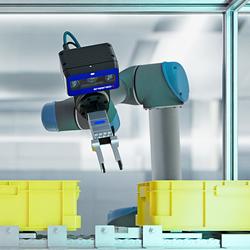
Nion: Next-level time-of-flight
The new Nion 3D camera advances Time-of-Flight (ToF) technology with exceptional resolution, speed, and industrial robustness. Designed for demanding applications such as logistics, warehousing, industrial automation, and robotics, Nion delivers high-resolution depth data with real-time performance for faster, safer, and more flexible operations. At its core is the 1.2-megapixel Time-of-Flight sensor AF0130 from onsemi's Hyperlux ID family, offering up to four times the resolution of conventional VGA-based ToF cameras and significantly higher data density. Active 940-nm laser illumination ensures accurate and stable measurements in low-light conditions, artificial lighting, and even direct sunlight. With an IP67-rated housing, Nion is built for reliable operation in dusty, wet, and thermally challenging industrial environments. A user-friendly API with IDS peak support and compliance with the GigE Vision standard enable fast integration and flexible deployment in high-resolution 3D applications. The Nion 3D camera is now available from IDS Imaging Development Systems.