Spider robots on the move for additive manufacturing
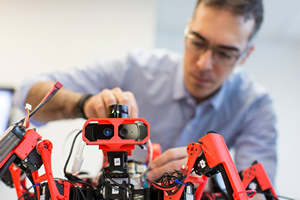 Stuart Nathan for The Engineer: One possible vision of the future could be taking shape at Siemens Robotics Labs at Princeton in New Jersey, where a team of engineers is developing autonomous robots equipped with vision, processing and additive manufacturing systems, designed to cooperate on additive manufacturing tasks.
In the form of robotic spiders, the systems are aimed at applications such as collaborative manufacture of automotive bodies, ship hulls or aircraft fuselages, explained project leader Livio Dalloro, head of Siemens Product Design, Modelling and Simulation Research Group.
Like several concepts in mobile additive manufacture, the Spider bots grew out of a concept to build bases for exploration on the Moon and other planets.
Still very much in development phase, the Siemens Spiders currently print in a mixture of cornstarch and sugars, but plastics and even concrete are possible for future generations. The aim of the project was to develop manufacturing machines that can autonomously evaluate a task, divide it between themselves and collaborate to complete it. For example, when an individual robot reaches the end of its battery charge, it will transmit its position to a fully-charged unit that can take over while it recharges. Full Article:
Featured Product