"By optimizing robot programs, users can see a significant increase in productivity while generating more profit with their robot, using robots for short production runs, and delivering closest conformance to design." Carlos Marcovici, Robotmaster Authorized Partner, Brazil
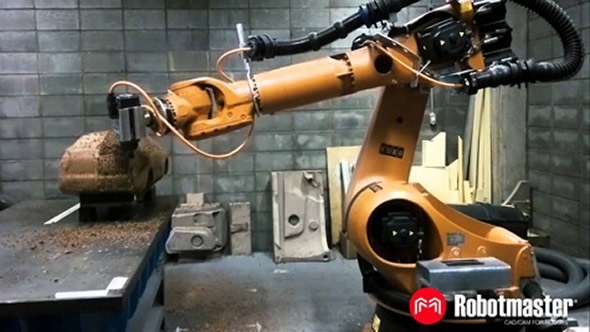 Robotic programming brings increased productivity and faster return on investment
Case Study from | Robotmaster
Imagine a sculptural replication for a new car model prototype or technical component for the automotive industry. This process can entail months of manual building and modification and be rather painstaking. Presently, a high-tech solution exists and is rapidly gaining widespread acceptance as a major breakthrough for automotive car modeling with emphasis on using robots and automatic programming. Carried out through a regular process for automotive prototype production, a model starts off in 3D design software where it is then passed to a sculptor to model the clay in the form of a car. Instead, the clay prototype is machined using robots. The robotic software allows for simulation, validation and optimization to robotic motion by turning a virtual car model into reality.
According to Carlos Marcovici, Robotmaster Authorized Partner, “With a 3D model, the robot trajectory is optimized to produce a precise and error-free robot program.”
Marcovici goes on to state that, “Because this is programming and simulation software, it graphically displays robotic errors such as: joint limits, singularities, out of reach and collisions. The programming software is developed to work with each robot manufacturer’s code to generate optimized robot motion.”
One of the key features of Robotmaster is that a robot trajectory is created directly off the 3D geometry. “With Robotmaster, you get optimized error-free robot programs”, explains Marcovici.
A proven solution within the aerospace, transport, and high technology industries to name a few, Robotmaster is also well poised within the automotive sector. Featured on Brazilian television, a story showcased a miniature version of the statue of Christ being milled using Robotmaster software, after being 3D scanned by a drone. Marcovici is quick to illustrate that Robotmaster can also be used for 3D printing of miniature sculptures.
Furthermore, Marcovici goes on to state that, “This software is ideally suited to program robots for such tasks as material removal in milling, deburring, drilling, laser cutting, and plasma cutting on top of additive manufacturing such as laser cladding, welding, and non-contact inspection.” Common robot programming challenges typically include intricate user intervention or costly manual editing. “By optimizing robot programs, users can see a significant increase in productivity while generating more profit with their robot, using robots for short production runs, and delivering closest conformance to design”, mentions Marcovici.
Milling a car model from clay
The content & opinions in this article are the author’s and do not necessarily represent the views of RoboticsTomorrow
Robotmaster
Robotmaster, a Hypertherm Associates brand, is an offline, is an offline robot programming software that helps manufacturers maximize their robot's productivity with easy and efficient robot programming for a variety of applications such as cutting, trimming, milling, welding, spraying, polishing, sanding, grinding, deburring, and more. Robotmaster uses integrated CAD/CAM functionality to make robotic programming easy and intuitive for everyone, even first-time users.


Other Articles
Calculating the ROI of Offline Robot Programming Software
10 things to consider when exploring Offline Robot Programming software solutions
Have You Looked at Automating Fabrication Tasks in the Past? Why Didn't You?
More about Robotmaster
Featured Product