Smarter Robots are Ready for a New Type of Industrial Automation Customer
Leaders from industrial robot companies discuss how to introduce disruptive technology to underserved automation customers.
FRAMINGHAM, MA - OCTOBER 16, 2012 - Robot companies will discuss their methods for handling disruptive technologies from the world of research robotics and apply them to new market opportunities during RoboBusiness 2012 Leadership Summit taking place October 22-24, 2012 at Pittsburgh Marriott City Center in Pittsburgh, PA.
Energid and Robai plan to demonstrate a small-footprint robot arm, called the Cyton Gamma, which is now ready for use by industrial customers; the Cyton Gamma installs as simply as a computer monitor, weighs under five pounds, and starts at under $5,000.
"For Robai, we leveraged technology developed for NASA to enable the Cyton arms to reliably perform manipulation tasks," says David Askey, Co-Founder and CBDO at Energid. "Our approach is that powerful software can make robot training natural and intuitive, speeding deployment and reducing total cost of ownership ."
"Our obsession has been on ease of use," said Ranjan Mishra, lead mechanical designer of the Cyton Gamma. "For many tasks, anyone can train the Cyton simply by moving the arm through the desired motions; for more complex planning, an engineer can use the 3D graphical tasking environment. "
Robai hardened the Cyton Gamma for industrial applications by leveraging advanced control software from Energid Technologies and includes features such as easy-to-use training modes. It is designed to be safe near people, handles payloads up to a few pounds, and supports a wide range of manipulation and inspection tasks. Production engineers enjoy the ability to teach the Cyton Gamma where to reach, which objects to grasp and how to manipulate. It can lift an object, turn a knob, flip a lever, or gesture across a touch screen.
A major automobile manufacturer used the Cyton Gamma to reliably test knobs, buttons, and touchscreen interaction on a dashboard. The Cyton allowed repeated physical testing and refinement that would otherwise have required exhausting human effort. Using a robot for repetitive testing is safer and less expensive than manual testing and enables fine-grained defect logging.
Robai has also added support for the Robotic Operating System (ROS) so engineers can integrate the arms with other ROS enabled devices. Paul Evans, the Director of Manufacturing Systems Department at the Southwest Research Institute, says the development of the Robot Operating System (ROS) is one of the most exciting developments in robotics in recent years. ROS is software platform that will provide a common framework across industrial robotics applications.
Additional robots that have evolved from the research domain are being deployed within a major semiconductor manufacturer for the automated transport of semiconductor pods in Class 100 cleanrooms. Adept Technology, Inc. has hardened the software and autonomous mobile platforms from their 2010 acquisition of robot research company Mobile Robots, Inc.
"Adept is very pleased to have begun introducing mobile technology to the semiconductor and cleantech space through this initial production deployment with such a large and respected client," says Rush LaSelle, Vice President and General Manager of Adept Mobile Robots. "Our mobile products are delivering strong returns on invested capital throughout a diverse set of industries by increasing production flexibility, providing more deterministic delivery times when compared to manual processes, and enabling the redeployment of labor to high value tasks."
Adept, Energid, Robai, and the Southwest Research Institute will be giving talks during the workshop session "Rethinking Manufacturing with Robotics" on Monday, Oct 22, at the RoboBusiness Leadership Summit to convey how new technologies are now opening up underserved markets within the industrial automation space.
For media inquiries, please contact Erin Rapacki at rbls12media@gmail.com.
For sponsorship information, contact Rich Erb at rerb@ehpub.com or 508-663-1500 x331.
For more information and to register to attend visit www.robobusiness.com.
ABOUT ROBOTICS TRENDS MEDIA GROUP
Robotics Trends Media Group is the world's first integrated media company serving the burgeoning personal, service and mobile robotics marketplace: Robotics Trends Publishing (www.roboticstrends.com), Robotics Business Review (www.roboticsbusinessreview.com ); and Robotics Trends Events, which produces the RoboBusiness Leadership Summit (www.robobusiness.com), and the virtual conferences (www.robovirtualevents.com).
Featured Product
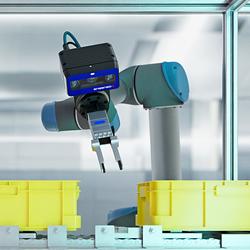
3D Vision: Ensenso B now also available as a mono version!
This compact 3D camera series combines a very short working distance, a large field of view and a high depth of field - perfect for bin picking applications. With its ability to capture multiple objects over a large area, it can help robots empty containers more efficiently. Now available from IDS Imaging Development Systems. In the color version of the Ensenso B, the stereo system is equipped with two RGB image sensors. This saves additional sensors and reduces installation space and hardware costs. Now, you can also choose your model to be equipped with two 5 MP mono sensors, achieving impressively high spatial precision. With enhanced sharpness and accuracy, you can tackle applications where absolute precision is essential. The great strength of the Ensenso B lies in the very precise detection of objects at close range. It offers a wide field of view and an impressively high depth of field. This means that the area in which an object is in focus is unusually large. At a distance of 30 centimetres between the camera and the object, the Z-accuracy is approx. 0.1 millimetres. The maximum working distance is 2 meters. This 3D camera series complies with protection class IP65/67 and is ideal for use in industrial environments.