Humanoid Robots to Drive Billions in Rod End Sales Over the Next Decade
Humanoid robots, from Tesla’s Optimus to Boston Dynamics’ Atlas, are swiftly moving from laboratories to commercialization. Widely regarded as the "Year of Mass Production," 2024 marks a pivotal moment as Embodied AI reshapes high-end manufacturing. According to Goldman Sachs, the humanoid robot market is projected to reach $38 billion by 2035, with shipments surpassing 1.4 million units, driven by labor shortages and advancements in AI technology.
As the humanoid robot market expands rapidly, it creates significant demand for specialized mechanical components. Rod ends, essential in robotic joints, are positioned to play a crucial role in this transformation. This growth not only opens doors to billions in new revenue but also presents an unprecedented opportunity for precision components manufacturers.
"We have been supplying rod ends to the U.S. aftermarket automotive industry for over a decade, but in recent years, we have seen significant growth in the industrial automation and robotics sectors. As a result, we are now investing more in new product development and testing," said Vivian Zhou, the founder of SYZ Machine.
Rod Ends in Humanoid Robot Articulation
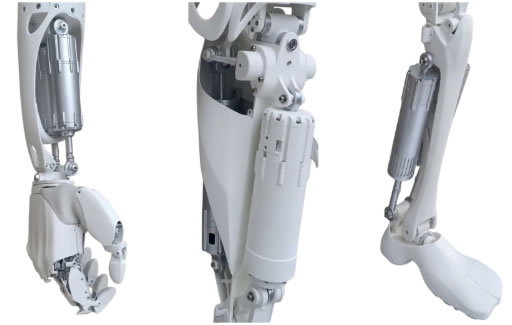
As humanoid robots evolve, mechanical components like rod ends are crucial for achieving fluid, human-like movements. One of the most common joint configurations in humanoid robots is the rotary + linkage system, where rod ends play a vital role in enabling precise articulation.
This configuration combines a rotary actuator with a linkage mechanism, translating rotational motion into controlled movements. It is ideal for joints such as knees and ankles, where flexibility, torque tolerance, and compactness are essential. The rotary + linkage configuration offers significant advantages: it ensures high load-bearing capacity, allows precise motion control, and optimizes space efficiency—making it a key factor in humanoid robots' ability to perform dynamic movements.
Rod ends, as integral parts of this system, help robots maintain stability while executing complex tasks. Their role in facilitating accurate, human-like motions positions them as a critical component in the rapidly growing humanoid robot market. As this market expands, the demand for rod ends is expected to rise significantly, driving both innovation and sales in the robotics and precision components industries.
How Many Rod Ends Does a Humanoid Robot Need?
The number of rod ends required in a humanoid robot depends on its design and the articulation of its joints. Here's an estimate based on typical humanoid robot configurations:
-
Upper Body:
-
Elbow Joint: 2 rod ends per elbow
-
Wrist Joint: 3 rod ends per wrist
-
Total for both arms: 5 rod ends per arm (2 for elbow + 3 for wrist)
-
-
Lower Body:
-
Knee Joint: 5 rod ends per knee (supports multi-linkage, torque, and load)
-
Ankle Joint: 3 rod ends per ankle (ensures stability and flexibility)
-
Hip Joint: 3 to 5 rod ends per hip (central pivot with high DOF)
-
-
Fingers:
-
Each finger joint: 2 rod ends (for dexterous hand manipulation)
-
Total for both hands: 20 rod ends (assuming 5 fingers per hand)
-
Estimated Total for a Single Humanoid Robot: 52 rod ends (combining upper body, lower body, and fingers)
Estimated Rod End Demand & Revenue from Humanoid Robot Boom
To estimate market potential, we start with practical assumptions about rod-end cost and robot production:
-
A typical rod end (Heim joint) — depending on size, material and precision — can cost anywhere from about US-$15 to $50 per unit in small-batch retail (entry-level rod ends).
-
For a high-precision, industrial-grade rod end used in humanoid robotics (which likely demands higher quality), a conservative average cost estimate might be around US-$25–40 per rod end.
Given 52 rod ends per robot, the estimated rod-end cost per robot would be:
-
Low side: 52 ×-US?$25 ≈ US-$1,300
-
High side: 52 ×-US?$40 ≈ US-$2,080
Now, according to Goldman Sachs, by 2035 global shipments of humanoid robots could reach 1.4 million units.
Thus, if all those robots use 52 rod ends each, total rod-end demand would be:
-
1.4 million robots × 52 rod ends ≈ 72.8 million rod ends
If we assume average rod-end price between US?$25–40, potential total rod-end revenue becomes:
-
Low end: 72.8 million ×-$25 ≈ US-$1.82?billion
-
High end: 72.8 million ×-$40 ≈ US-$2.91?billion
So — under conservative assumptions — the humanoid-robot boom alone could generate several-billion US dollars in rod-end sales by 2035.
Of course, real-world numbers might vary: bulk manufacturing pricing could lower per?unit cost, some robots may use fewer/more rod ends, or some joint designs might use alternative components. But this rough calculation already suggests a very sizable market — the projected growth of humanoid robots could lead to a demand for over 70 million rod ends by 2035. With prices ranging from US $25 to $40 per unit, this could generate $1.8 to $2.9 billion in rod-end sales
Featured Product