Top 5 Robot Trends 2021 – International Federation of Robotics
Annual installations of industrial robots more than tripled within ten years (2010-2019) reaching 381 thousand units in factories around the world. The International Federation of Robotics shows top 5 trends shaping industries around the globe.
Annual installations of industrial robots more than tripled within ten years (2010-2019) reaching 381 thousand units in factories around the world. The International Federation of Robotics shows top 5 trends shaping industries around the globe.
"The mission to combine traditional production with Â'go digital strategiesÂ' puts robots in a pole position," says Dr Susanne Bieller, General Secretary of the IFR.
Robots learn new tricks: Artificial intelligence software in combination with vision and other sensing systems, allow robots to master difficult tasks. One such task is bin picking, that in the past was only feasible for a human hand. New generations of robots are easier to install and program and they are connectable. Advances in communication protocols integrate robots seamlessly into automation and Industry 4.0 strategies.
Robots work in smart factories: The automotive industry pioneered smart factory solutions utilizing industrial robots throughout assembly lines that have dominated traditional automobile production for more than 100 years. The future belongs to networked interaction of robots and autonomous mobile robots (AMRs). When models are changed completely, it is only necessary to reprogram the robots and AMRs rather than to dismantle the entire production line.
Robots enter new markets: The connectivity breakthroughs contribute to increased robot adoption in manufacturing sectors that have only recently turned to automation, such as food and beverage, textiles, wood products and plastics. Ongoing digital transformation will lead to completely new business models, because producers can diversify more easily than ever.
Robots reduce carbon footprint: Investments in modern robot technology will also be driven by the requirement for a smaller carbon footprint. Modern robots are energy-efficient, thus directly reducing energy consumption of production. Through higher precision, they also produce fewer rejections and substandard goods.
Robots help to secure supply chains: The pandemic situation has made the weakness of globalized supply chains visible. Manufacturers have the opportunity to rethink supply with a completely different outlook. When productivity is leveled through automation, manufacturers have increased flexibility that may not have been available in high-wage countries like most of the European Union, North America, Japan or the Republic of Korea.
Full text version at: https://ifr.org/ifr-press-releases/news/top-5-robot-trends-2021
Video by IFR - The WorldÂ's Top 10 automated countries: https://ifr.org/ifr-press-releases/news/robot-race-the-worlds-top-10-automated-countries
About IFR
www.ifr.org
Featured Product
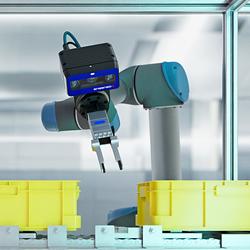
3D Vision: Ensenso B now also available as a mono version!
This compact 3D camera series combines a very short working distance, a large field of view and a high depth of field - perfect for bin picking applications. With its ability to capture multiple objects over a large area, it can help robots empty containers more efficiently. Now available from IDS Imaging Development Systems. In the color version of the Ensenso B, the stereo system is equipped with two RGB image sensors. This saves additional sensors and reduces installation space and hardware costs. Now, you can also choose your model to be equipped with two 5 MP mono sensors, achieving impressively high spatial precision. With enhanced sharpness and accuracy, you can tackle applications where absolute precision is essential. The great strength of the Ensenso B lies in the very precise detection of objects at close range. It offers a wide field of view and an impressively high depth of field. This means that the area in which an object is in focus is unusually large. At a distance of 30 centimetres between the camera and the object, the Z-accuracy is approx. 0.1 millimetres. The maximum working distance is 2 meters. This 3D camera series complies with protection class IP65/67 and is ideal for use in industrial environments.