Introducing Cortona3D RapidAuthor 14.3: new Applicability Editor, automatic generation of IPC Pages from ModelView in PLM XML, composite illustration, enhanced 2D authoring, and more
Cortona3D introduces the latest iteration of its technical documentation software, RapidAuthor 14.3. This release brings an array of enhancements designed to streamline the process of creating high-quality 3D animated and traditional 2D technical documentation.
Cortona3D introduces the latest iteration of its technical documentation software, RapidAuthor 14.3. This release brings an array of enhancements designed to streamline the process of creating high-quality 3D animated and traditional 2D technical documentation.
A notable advancement has been made in S1000D authoring with the introduction of the Applicability Editor in version 14.3. This tool streamlines applicability management, eliminating manual XML writing. Users can effortlessly create data module and content applicability by utilizing parameters from the applicability cross-reference table (ACT) data module. The editor enables the definition of applicability through a hierarchy of logical statements and facilitates populating the product cross-reference table (PCT) data module. The Applicability Editor is available in RapidManual, RapidCatalog, and RapidText.
RapidCatalog and RapidIllustrator users now have the power to create composite illustrations-combinations of diverse product and component views. These composite illustrations update automatically and enable the utilization of reusable templates across projects.
In RapidAuthor 14.3, users can generate vector illustrations with raster background, expedite common tasks in the Document Editor using new buttons, create more lifelike animations with the Phantom Box object, and much more.
Cortona2D Editor Pro introduces new functionality for splitting lines, single-segment polylines, and polybeziers into a specified number of equal segments. It also offers the capability to divide multi-segment polylines, polybeziers, arcs, and ellipses into individual segments.
Furthermore, the 2D Editor now supports masks to conceal elements within an image, a custom color palette, new Halo styles, enhanced editing of raster 2D images, and more.
Automated generation of IPC-pages directly from the root JT's ModelView during PLM XML file imports is now a feature in RapidAuthor 14.3 for Teamcenter. This process requires specific settings in the corresponding import profile. JT Reference Sets are also supported in this version.
RapidAuthor 14.3 offers substantial enhancements in authoring S1000D and DITA content within Active Workspace.
Featured Product
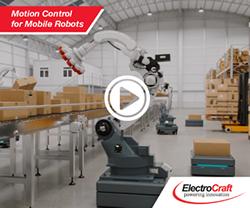
ElectroCraft's Motion Control for Mobile Robots
ElectroCraft is showcasing its award-winning mobile robot technology including their powerful and compact wheel drives, high-torque-density brushless DC motors, precision linear actuators as well as servo motor drive technology at a variety of conferences and tradeshows including the Boston Robotics Summit. Robotics Summit is the premier symposium for the sharing of ideas, technology, and market developments for robotic technologies across industries. Beyond a showcase and pitch of product, ElectroCraft is eager to participate in the collaborative discussion of challenges and opportunities that will shape the near and long-term robotic marketplace.