Google to Use Robots for Parcel Delivery
With Amazon announcing the launch of their Prime Air Project, Google too has decided to pitch itself as a worthy competitor in the parcel delivery race with the use of robots - a concept that Parcel2Go thinks will take the retail industry by storm.
Technology's ability to take huge leaps and bounds has allowed it to shape a number of different marketplaces - from personal pleasure to business productivity. And as consumers demand more instant gratification (thanks to on-demand technology enabling short-term solutions such as mobile payments and sharing content), companies are seizing the opportunity to have their goods distributed immediately - with the likes of Amazon and Google only too happy to help.
Les Yates, Marketing Executive, said: "Our broad experience has made us a household name both in the UK and overseas - and it's our reputation that has helped us establish a number of successful partnerships with many a leading courier service.
"What we've come to notice through our international connections is that with ever-changing trends, so the marketplace has had to make the relevant adaptations. We believe it's time that such elite technology is now readily accessible and available for each and every customer, and look forward to such innovations improving the modern landscape."
Parcel2Go already delivers packages to an impressive 240 countries, working with a number of parcel suppliers to process huge volumes of orders quickly and effectively. Sending out over two million parcels each year as well as becoming the first ever online parcel delivery service to reach 100,000 users, Parcel2Go constantly updates its services to ensure its customers receive quality standards at affordable rates.
http://www.parcel2go.com
Featured Product
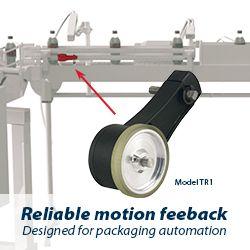
Model TR1 Tru-Trac
The Model TR1 Tru-Trac® linear measurement solution is a versatile option for tracking velocity, position, or distance over a wide variety of surfaces. An integrated encoder, measuring wheel, and spring-loaded torsion arm in one, compact unit, the Model TR1 is easy to install. The spring-loaded torsion arm offers adjustable torsion load, allowing the Model TR1 to be mounted in almost any orientation - even upside-down. The threaded shaft on the pivot axis is field reversible, providing mounting access from either side. With operating speeds up to 3000 feet per minute, a wide variety of configuration options - including multiple wheel material options - and a housing made from a durable, conductive composite material that minimizes static buildup, the Model TR1 Tru-Trac® is the ideal solution for countless applications.