Each motor requires high power density and precise control, all packed into a small form factor. TI's technology reduces the size of the board by integrating FETs, drivers and current sensing into one package.
 Semiconductor Innovations for the Next Generation of Robots
Q&A with Giovanni Campanella, Sector General Manager for Industrial Automation and Robotics | Texas Instruments (TI)
Tell us about yourself and your role with Texas Instruments (TI).
My name is Giovanni Campanella, and I am the sector general manager for industrial automation and robotics at TI. In my role, I lead a team of engineers that develop advanced, system-level solutions to help customers around the world address their industrial design challenges.
As for my background, I earned my bachelor's degree in electronics and telecommunication engineering from the University of Bologna and later completed my master's degree in electronic engineering at the Polytechnic University of Turin.
What are the biggest engineering challenges in designing the next generation of robots, and how are semiconductor innovations helping overcome them?
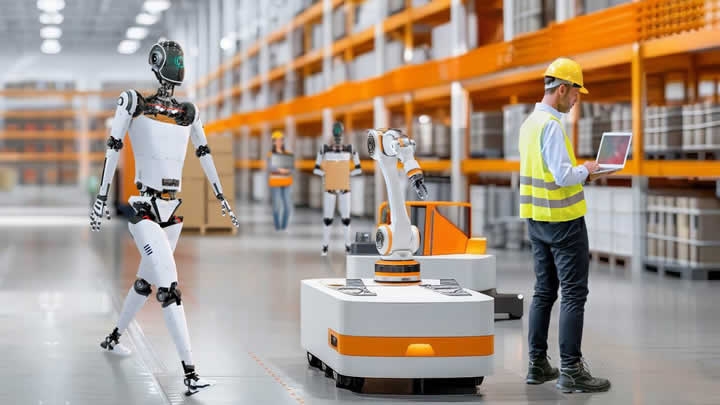
As the deployment of humanoid and mobile robots continues to grow across different sectors, including warehouses, factories and even in our homes, TI is working alongside our customers to address their key design challenges.
One of the main challenges is the electronic complexity of these systems, particularly humanoids. Think of their hands – to enable human-like dexterity, each finger needs to have three or four motors. Depending on the number of fingers, you could have anywhere between 20 to 25 motors in one hand. Each motor requires high power density and precise control, all packed into a small form factor. TI’s technology reduces the size of the board by integrating FETs, drivers and current sensing into one package, and we also offer very small C2000™ real-time MCUs for motor control.
As robots work closer to people in factories and warehouses, they must also meet the rigorous requirements of functional safety standards such as IEC 61508 and ISO 13849. TI’s functional safety-compliant products, documentation and safety experts help engineers streamline their functional safety system certifications. Additionally, my team works closely with certification bodies like TÜV SÜD to define motor control safety concepts, meaning our semiconductors are engineered with the latest component-level requirements in mind. We’re integrating safety capabilities across our analog and embedded portfolios, including our processors, motor control MCUs, gate drivers and sensors.
What semiconductor technologies and components are most critical for enabling precise, efficient, and safe motor control in mobile and humanoid robots?
For mobile and humanoid robots to move naturally and safely, their motor control systems need to operate in real-time control loops where sensor data is gathered and processed, then motor commands are adjusted, all within microseconds. The semiconductors that enable real-time control loops include precise sensing technologies, microcontrollers and processors, and actuation components.
Sensors continuously measure motor currents, voltages, position and temperature to help capture data for motor control systems with incredible accuracy. For processing, TI’s C2000™ real-time MCUs and Arm®-based devices can execute complete current control loops in less than 1 microsecond, enabling robots to achieve highly accurate positioning. TI also provides advanced actuation components, including GaN FETs with integrated gate drivers that deliver high efficiency, which is critical for battery-powered robots.
TI's complete portfolio of sensing, processing, control and communication technologies offer power efficiency, performance and low-latency response times to enable smaller, more reliable real-time control systems. Together, these semiconductors provide the deterministic control essential for robots to operate in fast-paced environments and safely collaborate with humans.
How do advanced sensing technologies - like lidar, radar, and vision sensors – work together to improve autonomy, responsiveness and safety in dynamic environments?
Humanoid and mobile robots rely on a variety of sensors to detect and understand their environment, including lidar, radar and cameras. These all work together through a process called sensor fusion, where a processor combines data from different sensing technologies to create a more comprehensive and accurate picture of the robot’s surroundings. The system also gains redundancy, so if one sensor fails or struggles in certain conditions, others can compensate.
When you layer edge AI on top of that sensor fusion, a robot can perceive its surroundings, classify objects, make informed decisions and take appropriate actions in real time. This enhances its ability to perform complex tasks such as navigating uneven terrain, grasping objects of different shapes and sizes, and working in dynamic, real-world environments. For example, think about a robot walking through a busy warehouse. With AI-enabled sensor fusion, it can run advanced perception algorithms to determine whether an object in its path is a person, a box or even another robot, predict how it might behave, then determine whether to stop or navigate around it. This all happens in a split second to enable safer, more autonomous operation in human-centric environments.
Why is real-time communication between subsystems (motor control, sensing, computing, power) essential in modern robotic architectures, and how does semiconductor design enable this?
Today’s humanoid and mobile robots are becoming more complex and precise, with more degrees of freedom and the ability to assess, adapt and respond to their environment within milliseconds. This requires real-time coordination between motors, sensors, processors, and power systems, all within a space- and weight- constrained frame that must remain reliable in noisy environments. High-bandwidth, low-latency communication interfaces provide the backbone for quick data transfer across these different systems. TI offers semiconductors that support various wired and wireless communication protocols for industrial applications.
One example is TI’s single-pair Ethernet physical layers (PHYs). Instead of requiring multiple wires bundled together, single-pair Ethernet technology delivers high bandwidth data transfer through a single twisted pair. This simplifies the wiring architecture, helping reduce cable weight and improve system mobility. The accuracy of such devices helps the dozens of motors in a humanoid coordinate smooth motions.
For vision-based applications, TI’s V3Link™ high-speed serializers and deserializers enable the transmission of high-resolution video from system to system with minimal delay. Engineers can use V3Link ICs to synchronize multiple cameras and enable AI for real-time video capture, transfer and analysis in humanoid and mobile robots.
How do high-performance embedded processors and software enable smarter, more adaptive robotic platforms?
Modern robotic systems are challenged to manage a high number of tasks simultaneously—they're processing AI workloads, running real-time control loops, fusing data from multiple sensors, and doing all of this while meeting strict safety standards.
High-performance embedded processors address this challenge through their heterogenous architecture, where different cores handle these computing tasks. There are high-performance cores handling the operating system and applications, real-time cores managing precise motion control and specialized accelerators running AI models directly on the device. TI offers a broad portfolio of microcontrollers and processors with scalable performance and hardware accelerated vision, sensor fusion and edge AI computing. These devices are highly integrated, allowing engineers to design functionally safe perception systems with low power consumption, small form factor and optimized system cost.
On the software side, TI has worked to make development faster and more accessible for engineers. We offer a comprehensive development environment with support for both open-source and real-time operating systems. TI also provides easy-to-use tools like Edge AI Studio, which simplifies the entire process of developing, benchmarking and deploying AI models. This means robotics developers can iterate faster and accelerate time to market for their robots.
The content & opinions in this article are the author’s and do not necessarily represent the views of RoboticsTomorrow
Featured Product