Top Trends Robotics 2020 - International Federation of Robotics
New technology trends and market developments enable companies to react to changing requirements. The International Federation of Robotics shows top trends to innovate.
From 2020 to 2022 almost 2 million new units of industrial robots are expected to be installed in factories around the world. New technology trends and market developments enable companies to react to changing requirements. The International Federation of Robotics shows top trends to innovate.
"Smart robotics and automation are vital to deal with new consumer trends, demand for product variety or challenges from trade barriers", says Dr. Susanne Bieller, General Secretary of the IFR. "New technological solutions pave the way for more flexibility in production."
Simplification, Collaboration and Digitalization are key drivers that will benefit robot implementation.
Robots get smarter
Programming and installation of robots become much easier. How this looks in practice: Digital sensors combined with smart software allow direct teaching methods, so-called "Programming by Demonstration". The task that the robot arm is to perform is first executed by a human: He literally takes the robot arm and hand-guides it through the movements. This data is then transformed by the software into the digital program of the robot arm. In future, machine learning tools will further enable robots to learn by trial-and-error or by video demonstration and self-optimize their movements.
Robots collaborate with workers
With the ability to work in tandem with humans, modern robotic systems are able to adapt to a rapidly changing environment. The range of collaborative applications offered by robot manufacturers continues to expand. Currently, shared workspace applications are most common. Robot and worker operate alongside each other, completing tasks sequentially. Research and Development (R&D) focuses on even more challenging methods to enable robots to respond in real-time. These solutions include voice, gesture and recognition of intent from human motion.
Robots Go Digital
Industrial robots are the central components of digital and networked production as used in industry 4.0. This makes it all the more important for them to be able to communicate with each other - regardless of the manufacturer. The so called "OPC Robotics Companion Specification", developed by a joint working group of the VDMA and the Open Platform Communications Foundation (OPC), defines a standardized generic interface for industrial robots to connect them into the Industrial Internet of Things (IIoT).
Please find the full text version here: https://ifr.org/ifr-press-releases/
About IFR
The International Federation of Robotics: www.ifr.org
Featured Product
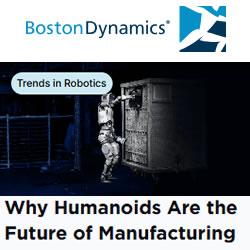
Boston Dynamics Webinar - Why Humanoids Are the Future of Manufacturing
Join us November 18th for this Webinar as we reflect on what we've learned by observing factory floors, and why we've grown convinced that chasing generalization in manipulation—both in hardware and behavior—isn't just interesting, but necessary. We'll discuss AI research threads we're exploring at Boston Dynamics to push this mission forward, and highlight opportunities our field should collectively invest more in to turn the humanoid vision, and the reinvention of manufacturing, into a practical, economically viable product.