SERVICE ROBOTS Record: Sales Worldwide Up 32% – International Federation of Robotics Reports
In terms of value, the sales of medical robotics accounts for 47% of the total professional service robot turnover in 2019. This was mainly driven by robotic surgery systems, which are the most expensive type in the segment.
Sales value of professional service robots increased by 32% to 11.2 billion U.S. dollars worldwide (2018-2019). The COVID-19 pandemic will further boost the market. High demand for robotics disinfection solutions, robotic logistics solutions in factories and warehouses or robots for home delivery are examples of this trend. This is according to World Robotics 2020 - Service Robots report, presented by the International Federation of Robotics (IFR).
In terms of value, the sales of medical robotics accounts for 47% of the total professional service robot turnover in 2019. This was mainly driven by robotic surgery systems, which are the most expensive type in the segment. Sales hit a new record of 5.3 billion U.S. dollars - up 28%. By 2022, medical robot sales have the potential to more than double by reaching 11.3 billion U.S. dollars. About 90% of medical robots are from American and European suppliers.
Professional Service Robots - logistics
The market value of logistics robots sold or leased was up 110% to 1.9 billion U.S. dollars. Autonomous mobile robots are part of today's smart factory. Therefore, a continued strong turnover growth of 40% or more per year seems possible. "The investment in service robots for logistics in manufacturing processes is amortized rapidly," says IFR President Milton Guerry. "Assuming 24 hour operation, the investment in service robots for logistics may be repaid within 2â€3 years and often much quicker. Given a 15 year lifetime, operating costs are around 5% of the annual investment. Highly developed systems often provide operational availability in the 98% plus range."
Personal and Domestic Service Robots
Service robots for personal and domestic use, which are produced for a mass market, are mainly in the areas of household robots. This include vacuuming and floor cleaning robots, lawn-mowing robots or entertainment robots. The total number of service robots for personal and domestic use increased by 34% to more than 23.2 million units sold in 2019. The value was up 20% to 5.7 billion U.S. dollars.
"We expect sales of both professional and personal service robots will continue to increase strongly," says Milton Guerry, President of the International Federation of Robotics.
Featured Product
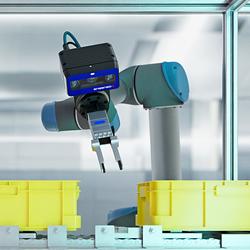
3D Vision: Ensenso B now also available as a mono version!
This compact 3D camera series combines a very short working distance, a large field of view and a high depth of field - perfect for bin picking applications. With its ability to capture multiple objects over a large area, it can help robots empty containers more efficiently. Now available from IDS Imaging Development Systems. In the color version of the Ensenso B, the stereo system is equipped with two RGB image sensors. This saves additional sensors and reduces installation space and hardware costs. Now, you can also choose your model to be equipped with two 5 MP mono sensors, achieving impressively high spatial precision. With enhanced sharpness and accuracy, you can tackle applications where absolute precision is essential. The great strength of the Ensenso B lies in the very precise detection of objects at close range. It offers a wide field of view and an impressively high depth of field. This means that the area in which an object is in focus is unusually large. At a distance of 30 centimetres between the camera and the object, the Z-accuracy is approx. 0.1 millimetres. The maximum working distance is 2 meters. This 3D camera series complies with protection class IP65/67 and is ideal for use in industrial environments.