NASA and The Cleantech Open Partner in Robotics Challenge
NASA has selected The Cleantech Open of Redwood, Calif., to manage the agency's Night Rover Challenge that will culminate in a competition in fall 2012
WASHINGTON, Sept. 21, 2011 - NASA has selected The Cleantech Open of Redwood, Calif., to manage the agency's Night Rover Challenge that will culminate in a competition in fall 2012. The event is a new Centennial Challenges prize competition seeking revolutionary energy storage technologies for future space robotic rover missions. NASA is offering a prize purse of $1.5 million to challenge winners.
The Night Rover Challenge is to demonstrate solar energy collection and storage systems suitable for rovers to operate through several cycles of daylight and darkness. During daylight, systems can collect photons or thermal energy from the sun. During darkness, the stored energy would be used to move the rover toward a destination and to continue its exploration work.
"The Cleantech Open runs the world's largest clean technology business competition and is a proven leader in developing clean technology startup entrepreneurs," said Larry Cooper, program executive for NASA's Centennial Challenges Program at NASA Headquarters in Washington.
"The team has significant experience in tech entrepreneurship and innovation, and access to expertise in aerospace, making them a great choice to manage the Night Rover challenge. We look forward to the competition and bringing together innovative teams with creative problem-solving ideas."
The objective of the competition is to encourage innovations in energy storage technology and system designs for space operations. In particular, NASA seeks solutions to meet the demands imposed by the daylight and darkness cycle on the moon. Energy innovations stemming from this challenge may be beneficial to broader terrestrial applications, including vehicles and renewable energy generation systems.
The Cleantech Open team is partnering with YouNoodle Inc., a San Francisco-based startup to manage the competition. The Cleantech Open and YouNoodle will begin preparations for the challenge, publishing rules and registering competitors for the competition.
NASA's Centennial Challenges seek unconventional solutions to problems of interest to the agency and the nation. NASA provides the prize purse, but the competitions are managed by non-profit organizations that cover the cost of operations through commercial or private sponsorships. Competitors have included private companies, student groups and independent inventors working outside the traditional aerospace industry. Unlike contracts or grants, prizes are awarded only after solutions are demonstrated successfully.
There have been 21 Centennial Challenges competition events since 2005. NASA has awarded $4.5 million to 13 different challenge-winning teams. Centennial Challenges is one of the ten Space Technology programs, managed by NASA's Office of the Chief Technologist. For more information about the program and descriptions of each of the challenge competitions, visit:
http://www.nasa.gov/challenges
For updates on the Night Rover Challenge visit:
http://NightRover.org
For more information about NASA's Office of the Chief Technologist, visit:
http://www.nasa.gov/oct
Featured Product
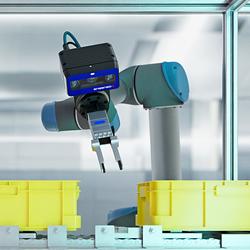
3D Vision: Ensenso B now also available as a mono version!
This compact 3D camera series combines a very short working distance, a large field of view and a high depth of field - perfect for bin picking applications. With its ability to capture multiple objects over a large area, it can help robots empty containers more efficiently. Now available from IDS Imaging Development Systems. In the color version of the Ensenso B, the stereo system is equipped with two RGB image sensors. This saves additional sensors and reduces installation space and hardware costs. Now, you can also choose your model to be equipped with two 5 MP mono sensors, achieving impressively high spatial precision. With enhanced sharpness and accuracy, you can tackle applications where absolute precision is essential. The great strength of the Ensenso B lies in the very precise detection of objects at close range. It offers a wide field of view and an impressively high depth of field. This means that the area in which an object is in focus is unusually large. At a distance of 30 centimetres between the camera and the object, the Z-accuracy is approx. 0.1 millimetres. The maximum working distance is 2 meters. This 3D camera series complies with protection class IP65/67 and is ideal for use in industrial environments.