The Four Pillars of 100% Inventory Accuracy and Where Most Automated Cycle Counting Systems Fall Short

Inventory accuracy breaks down at four distinct pillars: how often a warehouse counts, how much of the facility that count actually covers, how much the capture actually tells you about what is on the shelf and how quickly that data reaches the WMS.
Why Mobile Manipulators are Taking over Warehouses

The question is no longer whether mobile manipulation can work. It is where it should be deployed first. Traditional goods-to-person systems will not disappear overnight. They will continue to make sense for certain facilities and workflows.
Simplifying High-Density Warehouse Automation

The HaiPick Climb system was designed around a practical question: How can warehouses gain the storage density and throughput associated with AS/RS while making the solution easier to implement, operate, maintain and expand?
Simplifying Lift Truck Automation Deployment

Today's solutions are designed to reduce the complexity of deployment with standardized, configurable automation platforms that warehouses can get up and running — sometimes in as little as a day — with little to no software engineering required.
Inventory Intelligence: How AI is Leading the Third Wave of Warehouse Automation

We have automated the movement of goods and the tracking of goods, but we have not yet automated the truth about goods. Closing that gap is the third wave of warehouse automation, and it is being driven by AI and computer vision.
Charging Is the AMR Decision Nobody Models Until It's Too Late: How to Get Fleet Charging Right Before It Costs You

Charging strategy, battery chemistry, and the electrical infrastructure behind them quietly determine whether a fleet delivers the throughput it promised or stalls when demand is highest.
As AI-Powered Warehouse Automation Scales, the Role of Human Oversight Evolves

AI is helping teams move faster, while humans provide the judgment and physical-world context needed to determine where automation should remain advisory, where it should be supervised, and where it has proven reliable enough to act independently within defined limits.
Today's Warehouse Robotics Landscape

Robots are now more applicable for a wider range of warehouse tasks than ever before. Keep these trends and considerations in mind to make the right investments, achieve effective implementations, and realize the full business value of today's robotic systems
What Bastian Solutions' experience reveals about the future of AGV navigation

The question is no longer only whether an AGV can follow a route reliably, but whether its navigation technology allows the robot to adapt as processes, layouts, and demands change.
Industrial Flooring Upgrades: When Retrofitting Makes More Sense Than Full Replacement

Whether it's a mezzanine system or a ground-floor concrete slab, full replacement often means extended downtime, lost productivity, and significant labor costs.
Automate 2026 Q&A with Roboteon

At Automate Booth #19019 you'll see our platform in action -three Autonomous Mobile Robots (AMRs) and one order picking robot (Cobot) from four different vendors operating as if a single fleet, with complete interoperability.
AMRs in Real-World Warehouse Environments

Performance does not increase linearly as additional robots are deployed. Beyond a certain threshold, traffic conflicts, task contention, and route overlap can degrade system efficiency if orchestration logic is not sufficiently advanced.
Peak Season is the Lie Detector for Warehouse Robotics

Peak season pushes the limits of your building, but when done right, robots work quickly and continuously, smoothing out material flow. This results in better operations and increases warehouse output. This is the real value of robotic automation.
Robots Helping Robots: STL Uses HP SitePrint to Enable Geek+ AMR Navigation

STL partners with LE34, a certified HP SitePrint Service Provider, to precisely position QR codes for AMR navigation with ±2 mm accuracy—cutting project schedules from weeks to days in warehouse automation.
Avoiding "Vendor Lock-In'' with Warehouse Robotics

If companies don't choose wisely relative to robotic software, they can significantly limit their future robot options, and/or significantly add to the cost of future projects.
Records 1 to 15 of 96
Featured Product
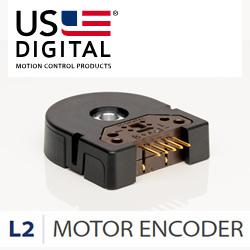
US Digital's New L2 Low Profile Motor Encoder
The L2 incremental encoder uses US Digital's proven EM1 optical encoder module and disk, which has billions of device-hours of dependable service in customer applications. This product continues US Digital's strong reputation for reliable, field-tested encoders. The L2 is US Digital's lowest height encoder that uses the EM1 module. It has a 0.75 in. bolt-spacing mount. The maximum resolution is 1250 CPR (5000 PPR with quadrature). The L2 comes with a single-ended output. Another benefit of the L2 incremental encoder is its fast installation. The cover snaps onto the base to secure the module. It is designed for use with a high-retention connector or cable (sold separately). Like all US Digital products, the L2 is designed and manufactured in Vancouver, Washington, USA. It is backed by prompt access to our technical and customer service teams with same-day shipping on most orders.
Robotics and Automation - Featured Company

Shenzhen Mosrac Motor Co., Ltd.
Shenzhen Mosrac Motor Co., Ltd. was established in 2010 and currently has around 350 employees across 2 locations in Shenzhen, China. As a leading motion control manufacturer, Mosrac implements standard and customized innovative solutions. As an original design or equipment manufacturer (ODM/OEM), we design and manufacture frameless motors, high-precision encoders, and robot joint modules from development through production, as well as other services. Our products are used across printing, packaging, food and beverage, medical equipment, warehouse and industrial automation, and various types of robots, including surgical robots, humanoid robots, and collaborative robots. These fields require high performance, high quality, and special custom solutions. High-performance motion control products improve system reliability, save energy, and increase their precision and accuracy. For this reason, we provide precise control of torque, speed, and position for machines with complex motion needs.