3D Potter Improves SCARA Robot Load Handling with Teknic ClearPath Servos

In these systems, the motion requirements are especially challenging because the payload is not fixed. As the arm extends, rotates, and dispenses material, the mechanical leverage changes continuously.

The Cost of System Rigidity: How Legacy Automation Falters While Adaptive Robots Excel

Adaptive robotics give the flexibility to respond quickly to production requirements while improving productivity and long-term ROI. Although legacy automation remains effective for some repetitive applications, its limited adaptability restricts operational agility.

The Motor as a Sensor

maxon MIND was developed to take condition monitoring and predictive maintenance to a new level. The solution analyzes data read from the controller during machine operation and detects patterns that indicate wear or malfunctions.

Evolving PLC Programming for Modern Automation

The most effective automation systems preserve the simplicity and predictability of classic PLC control while selectively embracing modern tools where they add real value.

The Real Bottleneck in Agentic AI Is Not the Model, It Is the Handoff

Governance maturity across the industry still has room to grow. Broader enterprise research found that only about one in five organizations have a mature governance model for autonomous AI agents, a gap that mirrors what is showing up on the manufacturing floor specifically.

Maintaining Fibre Optic Performance in Industrial Robotics

Even microscopic contamination on a fibre connector end face can interfere with light transmission. In robotic applications where precision, repeatability and uptime are critical, small amounts of contamination can contribute directly to performance issues.

Today's Warehouse Robotics Landscape

Robots are now more applicable for a wider range of warehouse tasks than ever before. Keep these trends and considerations in mind to make the right investments, achieve effective implementations, and realize the full business value of today's robotic systems

Powering the next era of AI in manufacturing: Why it's time to upgrade to the NVIDIA RTX PRO 4500 Blackwell Workstation Edition

It delivers groundbreaking AI acceleration, neural rendering and the headroom needed for today's most demanding professional workflows powered by 5th Gen Tensor Cores, 4th Gen RT Cores and advanced NVIDIA® CUDA® cores.

The Rise of Flexible Automation within the Supply Chain

Supply chain automation will become more intelligent, connected, and adaptive. AI-driven software will continue evolving from reactive monitoring toward predictive and prescriptive capabilities that help operations rebalance workloads and automatically optimize performance.

The Hidden Cost of Automation Downtime: Why IT Reliability Is the Real ROI Driver Behind Robotics and Smart Manufacturing

Manufacturers build the ROI case for automation around labor savings and throughput gains. They rarely build it around the cost of the automation itself going down — and that is usually the number that determines whether the investment actually pays off.

Key Features to Consider in Digital Twin and OLP Software

Together, digital twins and Offline programming (OLP) software enable manufacturers and integrators to move more of the deployment work away from the shop floor and into a safer, faster, and more flexible virtual space.

Building Resilient Fulfillment Networks with Robotics and Real-Time Logistics Data

Combining robotics and real-time data will positively impact supply chain management. As logistics becomes more complex, demanding, and international, these technological advances have come at the right time.

Overcoming Automation Anxiety: The Safety-First Approach to Robot Integration

Manufacturers build numerous features into their models to keep robots safe around humans. Similarly, those planning to bring robots into the workforce should take several preliminary automation integration steps to prioritize safety.

Embodied AI: Industrial Manufacturing's Answer to the Great Margin Squeeze

Embodied AI-enabled robotics helps companies address the "great margin squeeze" head-on and shift to a high-mix manufacturing approach with faster changeovers and fewer exceptions that stop the line — without adding engineering bandwidth.

Imitation learning is reshaping the training of physical AI for industrial environments

Imitation learning is changing how industrial robots are trained, shifting from rigid programming to learning through real-world interaction. Anders Billesø Beck explains why data quality, force and production-grade hardware matter.

Records 16 to 30 of 1373

First | Previous | Next | Last

Factory Automation - Featured Product

US Digital's New L2 Low Profile Motor Encoder

US Digital's New L2 Low Profile Motor Encoder

The L2 incremental encoder uses US Digital's proven EM1 optical encoder module and disk, which has billions of device-hours of dependable service in customer applications. This product continues US Digital's strong reputation for reliable, field-tested encoders. The L2 is US Digital's lowest height encoder that uses the EM1 module. It has a 0.75 in. bolt-spacing mount. The maximum resolution is 1250 CPR (5000 PPR with quadrature). The L2 comes with a single-ended output. Another benefit of the L2 incremental encoder is its fast installation. The cover snaps onto the base to secure the module. It is designed for use with a high-retention connector or cable (sold separately). Like all US Digital products, the L2 is designed and manufactured in Vancouver, Washington, USA. It is backed by prompt access to our technical and customer service teams with same-day shipping on most orders.

Robotics and Automation - Featured Company

TM Robotics (Americas) Inc

TM Robotics (Americas) Inc

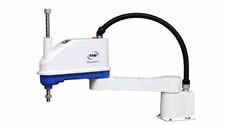
TM Robotics, in partnership with Shibaura Machine, formerly known as Toshiba Machine until 1st April 2020, offers a comprehensive range of industrial robots ideally suited for high-precision assembly, machine loading/unloading and material-handling applications that can be dust proof, clean room, or IP65/67. The company's extensive product line starts with a Cartesian solution available in thousands of combinations from single actuators to four-axis solutions; six-axis solutions that can include precise vision-control; and a complete range of SCARAs from low cost to the industry-leading SCARA with 1200-mm reach that can carry up to 20 kgs. TM Robotics sells and services robots throughout Europe, the Middle East, India, Russia, and Africa, as well as North, Central, and South America, from headquarters in Hertfordshire, England and Elk Grove Village, IL, USA. For more information, visit www.tmrobotics.com or follow us on Twitter, LinkedIn and YouTube.