Manufacturing's Next Phase: From AI Pilots to Autonomous Decisions on the Factory Floor

Manufacturers that scale successfully tend to begin with one line that has measurable scrap or changeover pain, build clean and time stamped machine data before adding models, and decide in advance what each system may adjust on its own and who owns the outcome.
Robotics Teams Should Train for the Counterexample Before They Scale

As organizations scale AI adoption at work, managers should ask: can the people responsible for the robot spot an unexpected result, say what they independently checked, and hand off the issue under the correct procedure?
Why Most Teams Are Still Building Their Edge AI Stack From Scratch

New detection, segmentation, and pose models arrive constantly. But getting a model onto a device on a factory floor, feeding it real sensor data, and having it do something useful offline is still mostly custom work.
Molded, Not Machined: 4 Design Rules for Injection-Molded Robot EOAT Components

Most teams prototype these parts by machining aluminum. Machining works for one or two cells. It breaks down at twenty. Lead times stretch and costs stack. Every design tweak waits on a CNC queue.
Humanoid Robots Are the Hype - Powder Metallurgy Is the Bottleneck Solver

A modern biped carries 30 to 40 joint actuators, and each one is a gearbox, a motor housing and a structural bracket packed into a space a fist could cover. That actuation stack - not the AI - is where unit economics go to die, and it is becoming a powder metallurgy problem.
Fluorosurfactant-Free Semiconductor Sealing Solutions

All semiconductor manufacturers have to be compliant with existing regulations. As a cutting-edge partner we produced these fluorosurfactant-free materials to help future-proof them against the legislation that will inevitably restrict PFAS usage.
Writing a Robot Field Service Contract: Pricing Models, SLA Traps and the Clauses That Matter

A practical guide for end users, integrators and robot makers on how service pricing models allocate risk, where SLA definitions go wrong, and what safety, insurance, data and exit terms to settle before anyone touches the robot.
Orbital Data Centers' Maintenance Problem: How Humanoid Solutions Will Bridge Autonomous Systems and Human Intervention

Given the growing demand for AI computing, companies are beginning to explore orbital data centers, with players like Axiom Space already advancing plans for computing and data-processing capabilities in space.
How to Troubleshoot Robot Vision Systems

Preventive maintenance and diagnostics are crucial for preventing problems from worsening, and these strategies are appropriate responses to some of the early warning signs robotics professionals may encounter in daily operations.
Who Trains the Robots? What 1,196 Open Robot-Training Jobs Say About the Physical-AI Workforce

The picture that "robot training" means a person in a lab with a VR headset is real, but it is the smallest slice. The bulk of the hiring is operations: vehicles, fleets and sites where robots meet the real world.
The Robotics Engineer Skill Set Is Changing. Here's What Senior Engineers Need Now

AI can accelerate coding, simulation can accelerate testing, and new tools can shorten development cycles, but someone still has to understand the system well enough to know whether the result will work outside the virtual environment.
How Should Engineers and Buyers Evaluate Robot AI

AI should do the dangerous parts and the boring parts, and people keep the interesting parts. The biggest safety gains will not come from a humanoid doing something dramatic. They will come from thousands of quiet inspections that catch the failure before the shift starts.
The Humanoid Robotics Funding Race: What the Money Tells Us About Commercial Readiness

Nearly $11.7 billion in disclosed capital has gone into humanoid robotics. Not one of the best-funded companies in the category has a humanoid you can buy. The companies that do are the ones that raised the least.
Balancing Torque and Battery Life in Next-Generation Autonomous Mobile Robots

The match between actuator and duty cycle now sets uptime and return on investment more firmly than planning algorithms can. Motor selection becomes less of a component-level choice and more of a strategic uptime decision.
From Robot Demo to Real Deployment - Seven questions buyers should ask before investing in humanoid robots

The central purchasing mistake is to treat a capability demonstration as if it were a deployment record. A sound evaluation starts with a narrower question: can this particular system perform our defined task, in our actual environment.
Records 1 to 15 of 3951
Featured Product
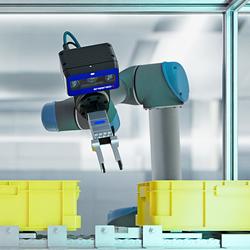
Nion: Next-level time-of-flight
The new Nion 3D camera advances Time-of-Flight (ToF) technology with exceptional resolution, speed, and industrial robustness. Designed for demanding applications such as logistics, warehousing, industrial automation, and robotics, Nion delivers high-resolution depth data with real-time performance for faster, safer, and more flexible operations. At its core is the 1.2-megapixel Time-of-Flight sensor AF0130 from onsemi's Hyperlux ID family, offering up to four times the resolution of conventional VGA-based ToF cameras and significantly higher data density. Active 940-nm laser illumination ensures accurate and stable measurements in low-light conditions, artificial lighting, and even direct sunlight. With an IP67-rated housing, Nion is built for reliable operation in dusty, wet, and thermally challenging industrial environments. A user-friendly API with IDS peak support and compliance with the GigE Vision standard enable fast integration and flexible deployment in high-resolution 3D applications. The Nion 3D camera is now available from IDS Imaging Development Systems.
Robotics and Automation - Featured Company

KNF Neuberger, Inc.
We are KNF. Founded in 1946 in Freiburg im Breisgau, Germany, we are a family-owned manufacturer that has established itself as a global solution provider specializing in the development, design, production and distribution of diaphragm pumps for the transfer of gases and liquids or for vacuum generation. With 24 locations and over 900 employees worldwide, we continue to expand our industry expertise and broad range of applications, including medical technology, inkjet, gas analysis and laboratory.