Key Features to Consider in Digital Twin and OLP Software

Together, digital twins and Offline programming (OLP) software enable manufacturers and integrators to move more of the deployment work away from the shop floor and into a safer, faster, and more flexible virtual space.
Why Every Robot Teleoperation Team Eventually Outgrows WebRTC

WebRTC gets robotics teams to a demo fast. It also breaks the moment the robot leaves the lab. If you are running WebRTC today, the question is not whether you will outgrow it but when, and what the next six months of engineering will be spent on while you do.
Imitation learning is reshaping the training of physical AI for industrial environments

Imitation learning is changing how industrial robots are trained, shifting from rigid programming to learning through real-world interaction. Anders Billesø Beck explains why data quality, force and production-grade hardware matter.
The Steam Controller and an Industrial Robot: An Unexpected Intersection

A standard wireless controller may seem far removed from the factory floor. ENCY Software's work on ENCY Hyper shows why tactile, analog input can still matter when programming industrial robots and cobots.
How the Modular Concept Can Help You Build a Future-Proof and Secure Robotic Computing Platform

Today, an intelligent robotic platform simultaneously has to run real-time multi-axis motion control, processes multiple data streams from various sensors including 2D and 3D vision cameras and/or LIDAR.
The Missing Layers in the Robotics Security Stack

Robotics today is like the cloud ecosystem of the early 2010s - scaling rapidly, but riddled with security risks and vulnerabilities.
Scaling Industrial Robots in the Age of AI

Robotic Foundation Models (RFMs), similar to large language models for text, are generative AI models trained from a dataset that enables robots to perform and predict a variety of tasks with high accuracy and adapt to changing conditions without reprogramming.
Calculating the ROI of Offline Robot Programming Software

Capital investments in advanced manufacturing environments require careful consideration, especially if that investment is for a new process or technology. If you are looking at"¯investing in OLP here are some things to consider about the potential return on investment (ROI).
Addressing Challenges in Software Solutions for Robots and Physical AI
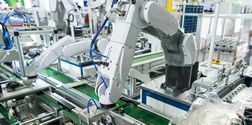
We leveraged our long heritage and leadership in robotics to create an AI software product that helps our customers overcome the challenges of traditional automation, accelerate set-up and deployment, and achieve greater ROI from their existing automation systems.
Robotic Software Market is Poised to Surpass USD 150 Billion by 2034

With businesses across industries striving to optimize operations, increase efficiency, and reduce costs, robotic software is becoming a crucial component of modern industrial and service applications.
NVIDIA Brings Generative AI Tools, Simulation and Perception Workflows to ROS Developer Ecosystem
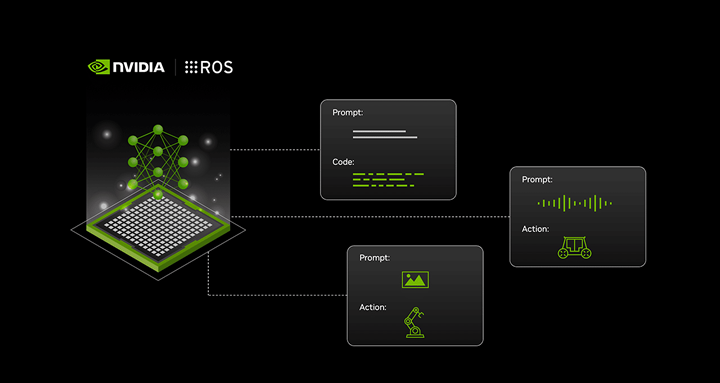
Among the reveals were new generative AI nodes and workflows for ROS developers deploying to the NVIDIA Jetson platform for edge AI and robotics.
How Remote Industrial Robotic Control Makes the Most of Automation

Some facilities struggle to achieve a substantial return on investment for their automation initiatives. Remote control systems can change that by making the most of robots' significant advantages while mitigating their biggest challenges.
Have You Looked at Automating Fabrication Tasks in the Past? Why Didn't You?
We recently hosted a webinar titled: Unlock Value-Stream Productivity with Robotic Cutting. During this webinar, we polled audience members. Our first question: Have you looked at automating fabrication tasks in the past. Most respondents said yes.
Why Use Offline Robot Programming Software and How to Get Started
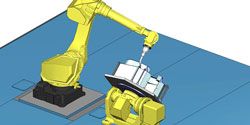
If you have added manufacturing robots to your facility, you are already aware of the advantages they provide and the ROI. Robots do have a downside, however, when it comes to programming-most of the time, they must be offline to be updated or programmed.
Robot Control: Using Native Programming Language or an External Controller?
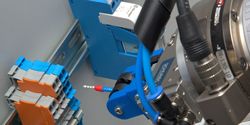
In service robotics as well as in academia, flexibly designable, use-case specific controllers are used, resulting in the respective robots to mainly act as actuators with low-level control systems but without individual intelligence.
Records 1 to 15 of 54
Featured Product

Elmo Motion Control - The Titanium Line, Redefining Limits of Motion Control
The next generation of motion control solutions that deliver outstanding performance. The Elmo advanced Titanium line of servo drives offers optimal performance and high-power density, delivering exceptional, intelligent, and compact drives that are operational within minutes. These single-axis and multi-axis servo drives, featuring top-performance multi-core processors, deliver superior productivity, Functional Safety, advanced networking, and local intelligence in a compact package.
Robotics and Automation - Featured Company
Elmo Motion Control Inc.
Elmo has been a motion control technology leader for over 35 years, with millions of servo drives working 24/7 worldwide. Elmo offers complete motion control solutions from design to delivery of cutting-edge servo drives, network-based multi-axis motion controllers, and integrated servo motors. All solutions can be customized and configured using Elmo's proprietary advanced and easy-to-use software tools for any machine in any industry, such as semiconductors, lasers, robots, life sciences, industrial automation, AGV, and more. The company employs more than 350 personnel with headquarters in Israel and offices in the United States, China, Germany, Italy, Korea, Singapore, and an additional manufacturing facility in Poland. Elmo has a worldwide distribution network. By advancing motion control with state-of-the-art technology, Elmo makes smart machines even smarter. As of 2022, Elmo is a Bosch Rexroth company.