
4 Amazing Advancements in Robotic Grippers to Keep an Eye On

As manufacturing sectors of all kinds struggle with a growing labor gap, these collaborative grip designs can help streamline facility workflows, reducing the labor necessary to complete tasks while keeping the facility flexible and adaptable.

Reliable Quality Inspection of Plastics With Autonomous Machine Vision

Autonomous Machine Vision (AMV) is a new approach to quality assurance, designed to be more than automatic, but autonomous, from determining the ideal number of samples the system needs to learn the characteristics of an item.

10 Factors Warehouse Managers Should Consider for Goods-to-Person Fulfilment

In this article, let's dive deeper into how it works and what factors you should consider if you are thinking to switch to using the Goods-to-Person fulfillment model.

Why Use Offline Robot Programming Software and How to Get Started

If you have added manufacturing robots to your facility, you are already aware of the advantages they provide and the ROI. Robots do have a downside, however, when it comes to programming-most of the time, they must be offline to be updated or programmed.

Parcel: A Lower-Cost Way To Automate Last-Mile Delivery Hubs

Solving the challenge of the last mile using traditional methods, like human teams and traditional automation systems, can require a massive upfront investment of capital and time - and often isn't enough to gain an edge in an already cutthroat market.

Could Cobots Be the Answer to the Welder Shortage?

The American Welding Society has predicted a deficit of 400,000 welders by 2024. According to specialist welding technologists K-TIG, a US welder's skills are in such high demand they can demand a salary of $100,000.

Robot Control: Using Native Programming Language or an External Controller?

In service robotics as well as in academia, flexibly designable, use-case specific controllers are used, resulting in the respective robots to mainly act as actuators with low-level control systems but without individual intelligence.

Standards, Guidelines & Industry Best Practices for Industrial & Collaborative Robots

The robotics industry is undergoing a significant transformation. There is a need to learn from the past, as multiple times, robots failed to behave as expected because of mechanical failure, power disruption, software issues, and environmental factors.

Contamination-free automation

Like any mechanism, robots can shed particles from belts, gasses from hoses and dust particles from the movement of the end effectors. It is this particle disbursement that can be the critical issue for clean room robotics.

Democratising Automation - the Benefits of No-code Robotics

The so-called 'no code' revolution in programming seeks to make the automation industry more autonomous and to democratize the use of robotics at the shop floor level.

Robots: from Automated to Autonomous

How an integrated hardware and software approach can simplify the development and deployment of robotics applications

Robotic Washdown in Food-Handling Environments

Heavy washdown and harsh chemical solutions used to clean robots in FDA and USDA sanitary environments for food processing can impact the robot finish, as well as leave condensation on robotic machinery that could potentially reach food products being handled.

Here's How Automated Packaging Gives Your E-commerce Business a Competitive Edge

Automated packaging solutions can streamline almost any business's operations, providing a potential competitive edge and benefits like reduced waste or lower labor needs.

Variance and Volume Advantageously Combined One of a Kind in Series

Up until now, users in the metal and plastics processing industries often faced a difficult choice: with CNC lathes and milling machines, one opted either for the largest possible variance or for large volumes, i.e., high quantities.

Choosing the Right Encoder for Your Robot

Most robots use servo motors to move their joints, calling for rotary or angle encoders. As speeds increase, so do the control dynamics the motors require, sometimes making vibration mitigation just as important accuracy and resolution.

Records 631 to 645 of 1393

First | Previous | Next | Last

Factory Automation - Featured Product
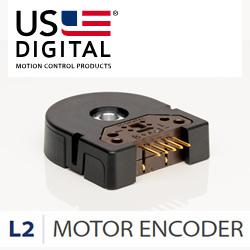
US Digital's New L2 Low Profile Motor Encoder

US Digital's New L2 Low Profile Motor Encoder

The L2 incremental encoder uses US Digital's proven EM1 optical encoder module and disk, which has billions of device-hours of dependable service in customer applications. This product continues US Digital's strong reputation for reliable, field-tested encoders. The L2 is US Digital's lowest height encoder that uses the EM1 module. It has a 0.75 in. bolt-spacing mount. The maximum resolution is 1250 CPR (5000 PPR with quadrature). The L2 comes with a single-ended output. Another benefit of the L2 incremental encoder is its fast installation. The cover snaps onto the base to secure the module. It is designed for use with a high-retention connector or cable (sold separately). Like all US Digital products, the L2 is designed and manufactured in Vancouver, Washington, USA. It is backed by prompt access to our technical and customer service teams with same-day shipping on most orders.

Robotics and Automation - Featured Company

OnLogic

OnLogic

A global industrial PC manufacturer and solution provider focused on hardware for the IoT edge, OnLogic designs highly-configurable computers engineered for reliability. Their systems operate in the harshest environments and power innovation in the evolving Internet of Things. Founded in 2003 as Logic Supply, the company has served more than 70,000 customers. OnLogic has offices in the US, Netherlands, Taiwan and Malaysia.
