The Imperative to Automate to Relieve Labor Constraints: The Reason to Attend the Automate Show

Because there is such a shortage of fork truck drivers for the foreseeable future, automation has become an imperative. The only alternative is to automate bringing loads of finish goods (or sub-assembly) from docks to warehouses and warehouse to docks.

Intelligent Robotics for Laundries Closes Automation Gap

With a system that uses both 2D and 3D cameras from IDS Imaging Development Systems GmbH, the young entrepreneurs are automating one of the last remaining manual steps in large-scale industrial laundries, the unfolding process.

The Importance of Investment in Robotic Automation

Most factories in the world are labor driven. With labor shortage crisis accelerated by Covid, which led to millions of unfilled jobs, manufacturers are in extreme pain and are unable to address customer demand.

Reinventing Intralogistics

A comprehensive approach to automation requires networking - not just between the individual components. Because for something really ground-breaking to emerge, already the development must be aligned.

What's the Difference Between AGVs and AMRs?

We have been hearing a lot about AGVs and AMRs in warehouses and fulfillment centers. But do you understand the differences between these two? Let's find out from the experts.

Simulating Heat Transfer in Power Cables Using the Finite Element Method (FEM)

Choosing the right cable to use in any application depends on many parameters. One of the most important is its ability to thermally resist a maximum imposed current.

Why Are You Still Manually Programming Your Robot?

Robots were first introduced to manufacturing assembly lines in 1978. Since then, the hardware (mechanics and control systems) has improved significantly. Yet the way these robots are programmed has not changed very much.

Medical Exoskeleton for Rehabilitation

Harmonic Bionics has developed a patented robotic actuator, which uses a load cell that is mechanically isolated from any extraneous loads. The result is that each load cell can sense the force exerted by only the joint of the robot it is mounted to.

Engineers Meet Industry Demand By Growing Their Robotics & IAS Expertise

For engineers with a traditional background in mechanical, electrical or computer engineering, specializing in IAS can accelerate their career progression and potentially make them more money.

High Performance Inertial Sensors for Robotic Systems

The next generation of robotic systems require high performance inertial sensors but also demand high volume, low cost solutions.

Smart, Compact Electromechanical Actuators Improve Productivity and Space Efficiency for Industrial AGVs

The more functionality AGV designers can pack into a small footprint, the greater will be the value to the end-user. Choosing the right actuation technology is critical to that value, and AGV designers are increasingly choosing smart electromechanical actuators.

Understanding The Opportunities for AI-Cameras and LiDARs for Smart Road Infrastructure

With advancements in artificial intelligence (AI) and 5G network connectivity, smart-road infrastructure technology offers the promise of being added to many different roads, bridges, and other transit systems across the U.S.

Using an LVDT as a Robotic Micrometer or Automated Height Gauge

Collaborative robots can be used to automate measurements currently made with manual micrometers, height gauges, and calipers. In this article, we'll look at how to automate each of these manual gauging tools.

Making Robotic Programming Easier for the Fabrication Industry

OLRP provides a virtual environment to complete robot programming without taking the robot offline, thereby simplifying complex and time-consuming programming.

Time of Flight Forges Ahead: Design Tips to Boost 3D Performance and Cut Integration Time & Cost

Our newest hands-on guidebook describes how you can optimize the benefits of Time of Flight by considering various factors such as the environment of the application and the target object properties in the scene.

Records 436 to 450 of 2067

First | Previous | Next | Last

Featured Product
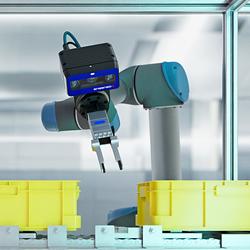
3D Vision: Ensenso B now also available as a mono version!

3D Vision: Ensenso B now also available as a mono version!

This compact 3D camera series combines a very short working distance, a large field of view and a high depth of field - perfect for bin picking applications. With its ability to capture multiple objects over a large area, it can help robots empty containers more efficiently. Now available from IDS Imaging Development Systems. In the color version of the Ensenso B, the stereo system is equipped with two RGB image sensors. This saves additional sensors and reduces installation space and hardware costs. Now, you can also choose your model to be equipped with two 5 MP mono sensors, achieving impressively high spatial precision. With enhanced sharpness and accuracy, you can tackle applications where absolute precision is essential. The great strength of the Ensenso B lies in the very precise detection of objects at close range. It offers a wide field of view and an impressively high depth of field. This means that the area in which an object is in focus is unusually large. At a distance of 30 centimetres between the camera and the object, the Z-accuracy is approx. 0.1 millimetres. The maximum working distance is 2 meters. This 3D camera series complies with protection class IP65/67 and is ideal for use in industrial environments.

Robotics and Automation - Featured Company

Oriental Motor Corp. USA

Oriental Motor Corp. USA

Since our founding in Japan in 1885, Oriental Motor globally has been providing the optimal motion systems as part of our total service, to meet the widest market demands. We manufacture and sell AC Motors, Stepper and Servo Motors, Linear and Rotary actuators, Network Solutions, Accessories and Thermal Management solutions. Oriental Motor's sales and service network is international, with offices throughout North America, Europe and Asia.